
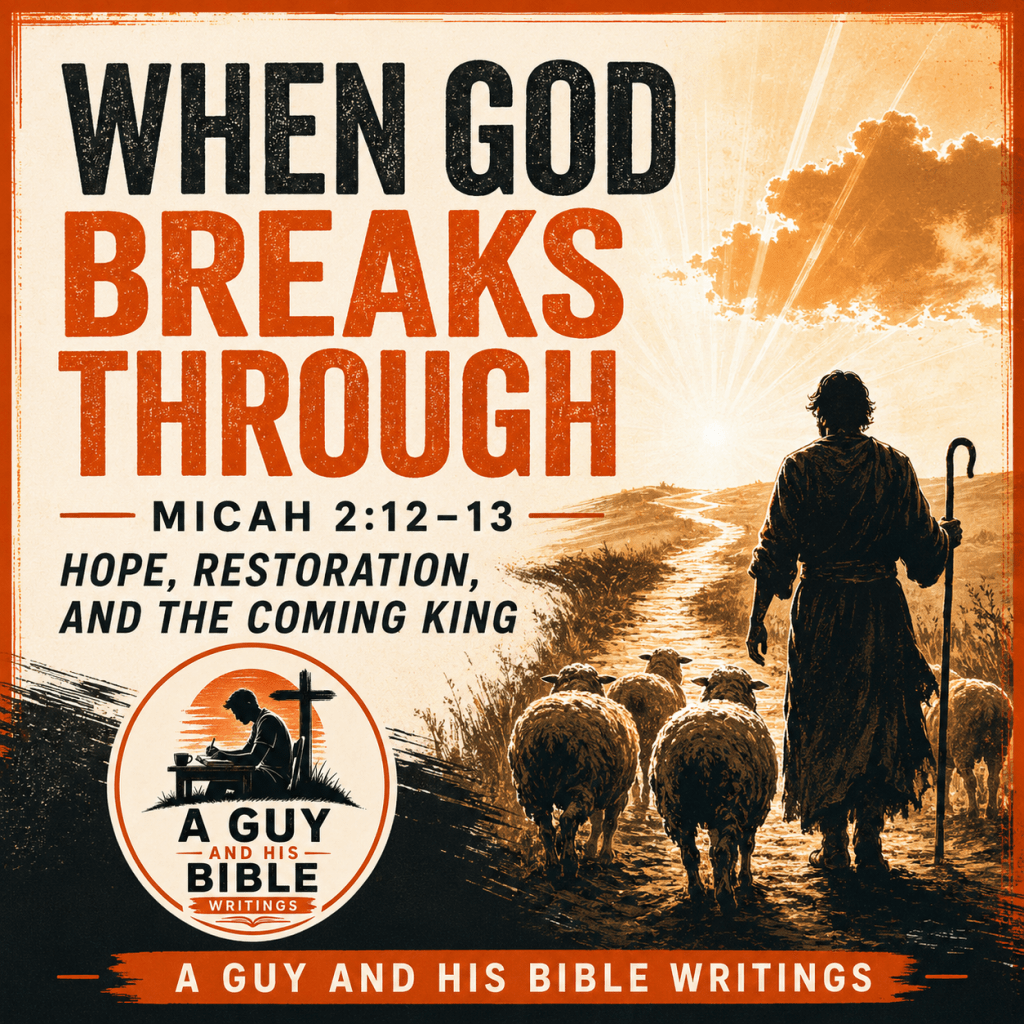
The second chapter of Micah contains some of the strongest warnings in the entire book.
Micah confronted people who were using their power to take advantage of others. They coveted fields, seized homes, oppressed families, and treated people’s inheritance as something they could take for themselves. False prophets made matters worse by telling the people what they wanted to hear. Instead of confronting sin, they promised comfort, prosperity, and security.
The message was clear: judgment was coming.
Then, without warning, the tone changes.
After exposing corruption, condemning oppression, and announcing judgment, God gives His people a promise of restoration. Micah 2:12–13 shines like a beam of light breaking through a dark sky.
Judgment would come, but judgment would not be God’s final word.
The Lord would gather His scattered people. He would protect them like a shepherd caring for his sheep. He would break through every barrier holding them captive. He would lead them forward as their King.
These verses remind us that although God takes sin seriously, He remains faithful to His promises. He does not abandon His people. He disciplines, restores, gathers, delivers, and leads.
Hope Does Not Ignore the Seriousness of Sin
The placement of Micah 2:12–13 is important.
God’s promise of restoration does not erase everything that came before it. The people had sinned against Him. They had oppressed the vulnerable, abused their authority, rejected correction, and preferred comforting lies over uncomfortable truth.
Their actions mattered, and God’s judgment was justified.
True biblical hope never pretends that sin is unimportant. It does not tell unrepentant people that everything is fine when they continue to rebel against God. It does not offer peace without repentance or restoration without surrender.
The false prophets of Micah’s day offered that kind of message. They wanted to speak about blessing without speaking about obedience. They promised security while ignoring injustice. They tried to comfort people who had no intention of turning back to God.
That was not hope. It was deception.
At the same time, conviction without hope can leave people believing that they are beyond redemption. It can expose the wound without pointing people toward healing.
A faithful proclamation of God’s Word must include both truth and grace. We must honestly confront sin, but we must also point people toward the God who saves sinners.
Micah does both.
He announces judgment, but he also declares that God’s mercy is greater than the darkness surrounding His people. Punishment would not be the end of their story. God still had a plan to gather, restore, and lead those who belonged to Him.
The Lord Gathers His People as Their Shepherd
God promises to gather the remnant of Israel and bring them together like sheep in a fold.
The image is one of safety, protection, care, and belonging.
Sheep that have been scattered are vulnerable. They can become lost, injured, or attacked. They need a shepherd who will search for them, gather them, protect them, and lead them to a place where they can be nourished.
That is exactly what God promises to do.
Israel would experience the consequences of its rebellion. Enemies would invade the land. People would be displaced, scattered, and eventually carried into exile. Yet even in judgment, God would preserve a remnant.
The word “remnant” carries both a warning and a promise.
It warns that judgment will bring real loss. The nation will not escape the consequences of its rebellion completely. Sin is destructive, and refusing to repent always carries consequences.
But the remnant is also evidence of God’s mercy. God will not allow judgment to destroy His covenant purposes. He will preserve people who trust Him, gather them together, and continue His work through them.
The survival of the remnant would not be the result of Israel’s strength, wisdom, or military power. It would be the result of God’s faithfulness.
There were partial fulfillments of this promise throughout Israel’s history. God preserved Jerusalem during the Assyrian invasion. He later brought Jewish exiles home from Babylon. Each deliverance demonstrated that God had not forgotten His people.
However, the promise reaches beyond any single historical event. It points toward the great Shepherd-King who would ultimately gather, protect, and restore God’s people.
Jesus identified Himself as the Good Shepherd in John 10. He knows His sheep, calls them by name, gives His life for them, and promises that no one can take them from His hand.
Jesus does not merely point lost sheep toward safety. He personally comes to find them.
He gathers people who have been scattered by sin. He welcomes those who feel forgotten. He carries those who are weak. He protects those who belong to Him and leads them into the abundant life found in His presence.
Our hope is not that we will somehow find our own way back to God. Our hope is that the Shepherd has come looking for us.
The Lord Breaks the Power of Bondage
Micah then describes someone who goes before the people and breaks open the way.
This figure has often been called “the Breaker.”
The picture is of God’s people being confined or surrounded. A wall, gate, enemy army, or some other obstacle appears to prevent their escape. They do not have the power to open the way for themselves.
Then the Breaker steps forward.
He creates an opening where there was no opening. He removes the obstacle. He passes through first, and the people follow the path He has made.
This is not a picture of human determination. It is a picture of divine deliverance.
The people are freed because someone stronger than their captors goes before them.
This image points powerfully toward the work of Jesus Christ.
Humanity was trapped in bondage to sin. We could not remove our guilt, defeat death, overcome condemnation, or reconcile ourselves to God. Religious activity could not free us. Moral improvement could not erase our past. Human effort could not break the chains holding us captive.
Jesus entered our condition and did for us what we could never do for ourselves.
Through His death, He paid the penalty for sin. Through His resurrection, He defeated the power of death. Through His grace, He opened the way for sinful people to be reconciled to God.
Hebrews 2:14–15 explains that Jesus shared in flesh and blood so that through His death He might defeat the one who held the power of death and free those who had lived in slavery through their fear of death.
Jesus is the One who breaks through.
- He breaks the power of sin.
- He breaks the chains of condemnation.
- He breaks the fear of death.
- He breaks the authority of the enemy.
- He breaks down every barrier that separates repentant sinners from God.
The people in Micah’s vision do not create their own escape route. They follow the One who has already broken through for them.
The same is true for us. Salvation is not achieved by creating our own path. We are saved by following the path Christ opened through His death and resurrection.
The Lord Leads His People as Their King
The One who breaks open the way is also described as the King who passes before His people.
God does not free His people and then leave them without direction. He delivers them so that they can follow Him.
Biblical freedom is not the ability to live without authority. It is freedom from the cruel authority of sin so that we can live under the gracious authority of Christ.
The people leave their captivity with their King in front of them and the Lord at their head. This is a triumphant procession. The Shepherd has gathered them. The Breaker has freed them. Now the King leads them forward.
This pattern can be seen throughout the story of Scripture.
God delivered Israel from slavery in Egypt and then led them through the wilderness. His presence went before them in the pillar of cloud and the pillar of fire. He did not merely bring them out of Egypt; He brought them to Himself.
In the same way, Jesus does not simply rescue us from judgment. He calls us to follow Him.
He becomes the Lord of our decisions, relationships, priorities, resources, ambitions, and future. The salvation He provides leads to a life of obedience.
Many people want Jesus to break their chains while resisting His right to lead their lives. They want deliverance without discipleship, forgiveness without surrender, and salvation without submission.
Micah’s vision does not allow that separation.
The Breaker is also the King.
The One who sets us free is the One we are called to follow.
Jesus Is the Shepherd, the Breaker, and the King
Micah 2:12–13 gives us three powerful pictures of the Lord’s saving work.
As the Shepherd, He gathers His scattered people.
As the Breaker, He destroys the barriers holding them captive.
As the King, He leads them into freedom and restoration.
All three pictures find their ultimate fulfillment in Jesus Christ.
- Jesus is the Good Shepherd who laid down His life for the sheep.
- Jesus is the mighty Deliverer who broke the power of sin and death.
- Jesus is the eternal King whose kingdom will never end.
Micah later prophesied that Israel’s ruler would come from Bethlehem and would shepherd His people in the strength of the Lord. Centuries later, Jesus was born in Bethlehem. He came as the promised Messiah, gave His life for sinners, rose from the grave, and now reigns as Lord.
One day, He will return and fully establish His kingdom. Every enemy will be defeated. Every promise will be fulfilled. God’s people will be gathered from every nation, and the King will reign forever.
The temporary deliverances experienced throughout Israel’s history were signs pointing toward that greater and final deliverance.
- God delivered Jerusalem from Assyria.
- God brought exiles home from Babylon.
- God sent Jesus to rescue sinners.
- God will one day complete the restoration of all things under the reign of Christ.
God’s Promises Are Certain
One of the strongest features of verse 12 is the certainty of God’s promise.
God does not say that He might gather His people if circumstances work in His favor. He declares that He will certainly assemble them and gather the remnant.
God’s promises are not vague wishes. They are settled declarations flowing from His unchanging character.
Circumstances may appear hopeless. God’s people may feel scattered. The enemy may seem powerful. The gate may appear closed, and the wall may seem impossible to overcome.
But no obstacle can prevent God from accomplishing His purpose.
The Shepherd will gather every sheep who belongs to Him.
The Breaker will remove every barrier standing in the way of His plan.
The King will lead His people safely home.
Our confidence is not based on the strength of our faith, the stability of our circumstances, or our ability to understand everything God is doing. Our confidence rests in the faithfulness of the One who made the promise.
What Micah 2:12–13 Means for Us Today
Although this passage speaks directly about God’s promises concerning Israel, it also reveals truths about God’s character and saving work that apply to believers today.
1. Judgment Is Not God’s Final Word for the Repentant
Sin is serious, and God’s warnings must never be ignored. Yet those who turn to Him will discover that mercy is available.
The gospel does not deny our guilt. It announces that Jesus carried our guilt on the cross.
No one is restored by pretending sin does not exist. Restoration begins when we confess our sin, turn from it, and trust in Christ.
2. God Has Not Forgotten His People
There may be seasons when we feel scattered, forgotten, or overlooked. Our circumstances may make us wonder whether God is still working.
Micah reminds us that the Shepherd knows where every sheep is.
God is not confused by our circumstances. He has not lost control of His flock. He remains faithful even when we cannot see how His promises will be fulfilled.
3. We Cannot Free Ourselves
The people needed someone to break open the way before them. We need the same.
Willpower cannot overcome the guilt of sin. Religious appearances cannot change the heart. Positive thinking cannot defeat death.
We need a Deliverer.
Jesus has already accomplished the work necessary for our salvation. Our responsibility is to repent, believe, and follow Him.
4. Freedom Requires Following the King
Christ does not deliver us so that we can return to the same patterns that enslaved us.
He sets us free so that we can live under His leadership.
Following Jesus means allowing His Word to shape our choices. It means surrendering our desires, rejecting sinful habits, loving our neighbors, serving others, and obeying Him even when obedience is costly.
5. The Church Must Reject Comfortable Lies
Micah confronted religious leaders who told people what they wanted to hear.
The church must resist the temptation to offer a message that promises blessing without repentance, comfort without conviction, or salvation without surrender.
We must proclaim the whole counsel of God. That includes the reality of sin, the certainty of judgment, the necessity of repentance, and the glorious hope of salvation through Jesus Christ.
Soft religion may attract attention, but it cannot transform lives.
Only the truth of the gospel can expose sin, offer forgiveness, break bondage, and lead people into genuine freedom.
The Deliverer Has Come—and He Is Coming Again
Micah’s message to a troubled nation was that the Deliverer was coming.
Christians can now proclaim that the Deliverer has come.
Jesus entered our broken world. He identified with us, carried our sin, died in our place, and rose victoriously from the grave. He opened the way out of bondage and into reconciliation with God.
We also live with the expectation that He is coming again.
When Christ returns, the work of restoration will be completed. Sin, suffering, injustice, and death will not have the final word. Jesus will reign openly as King, and His people will live in the freedom and glory of His kingdom.
Until that day, we follow the One who goes before us.
When the road is unclear, our King goes before us.
When we feel scattered, our Shepherd gathers us.
When we are confronted with barriers we cannot overcome, our Breaker opens the way.
Conclusion
Micah 2 begins with corruption, oppression, false teaching, and judgment. It ends with a Shepherd gathering His sheep, a Deliverer breaking open the way, and a King leading His people forward.
That is the hope of the gospel.
God does not minimize sin, but neither does He abandon repentant sinners to hopelessness. He comes to gather the scattered, free the captive, restore the broken, and lead His people home.
Whatever wall stands before you, remember that Jesus is the One who breaks through.
Whatever uncertainty surrounds you, remember that your King goes before you.
Whatever loneliness or fear you are experiencing, remember that the Shepherd has not forgotten His sheep.
Judgment is real, but it is not God’s final word for those who belong to Christ.
Salvation is.
Restoration is.
Hope is.
And the Lord Himself is at the head of His people.
 Patrick Ryan Lewis
Leave a comment