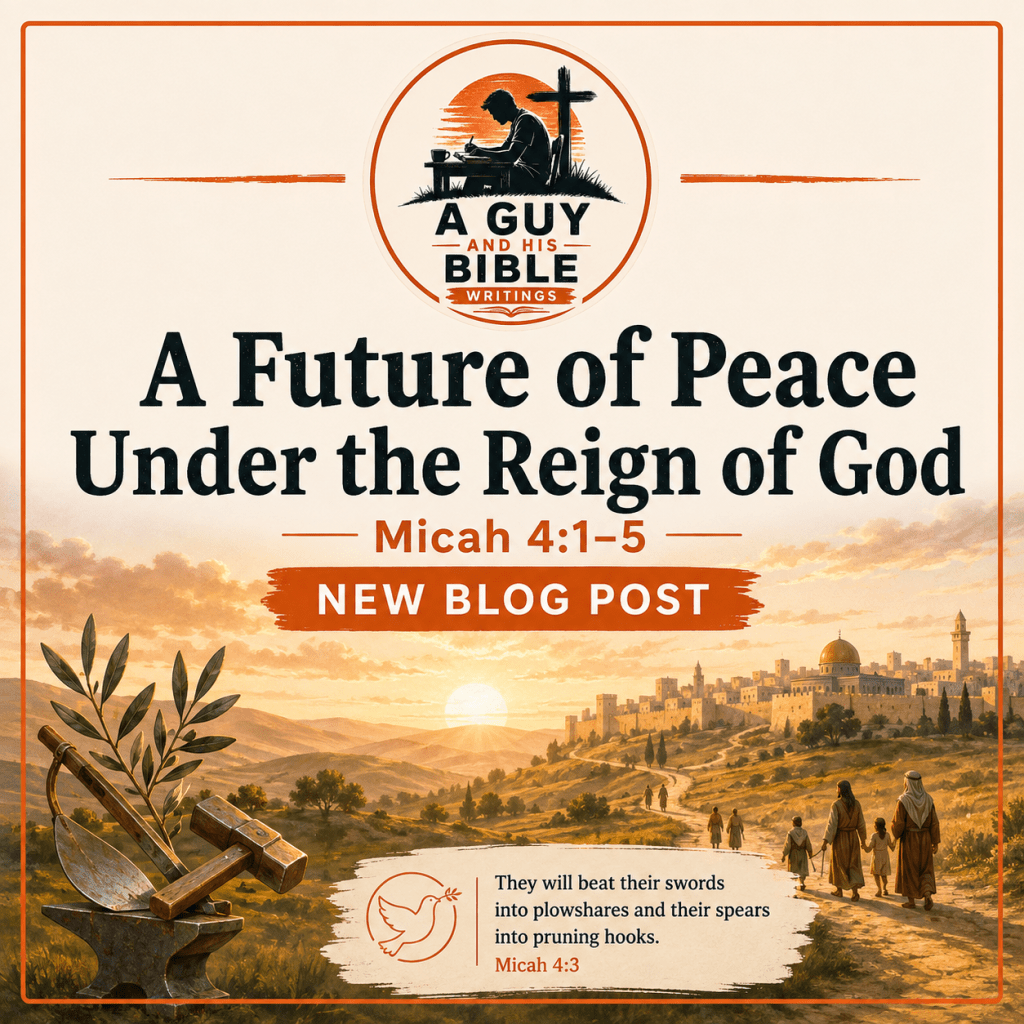
Micah 4:1–5
All Scripture references in this article are from the Christian Standard Bible (CSB).
One of the most beautiful things about the book of Micah is that judgment never gets the final word. Micah was called to confront a nation that had wandered far from God. He exposed corruption among political leaders, religious leaders, and those who were supposed to administer justice. He spoke against people who used their positions for personal gain and against a society in which the vulnerable were often exploited by the powerful. Micah 3 ends with an especially sobering warning concerning Jerusalem and Zion because of the sins of its leaders. Yet immediately after announcing judgment, Micah turns our attention toward hope. Micah 4:1–5 gives us a picture of what happens when God, rather than corrupt humanity, rules in perfect righteousness.
The transition between Micah 3 and Micah 4 could hardly be more dramatic. Micah 3:12 describes Zion being plowed like a field and Jerusalem becoming ruins because of the rebellion of its leaders. Then Micah 4:1 begins looking forward to the “last days,” when the mountain associated with the house of the Lord will be established and peoples will stream toward it. The place that appeared destined for destruction becomes the center of God’s righteous rule. Judgment is real, but judgment is not the end of God’s story. God is able to restore what sin has devastated and accomplish purposes that human rebellion cannot ultimately defeat.
This is an important truth for us to remember whenever we read the prophetic books. Biblical prophecy is not merely about predicting future events. The prophets reveal the character of God. They show us a God who takes sin seriously, demands justice, confronts corruption, disciplines His people, and at the same time remains faithful to His covenant promises. Micah has already shown us what human leadership looks like when selfishness takes control. Micah 4 now shows us what the world looks like when God’s righteous authority is fully recognized.
Micah 4:1 describes people streaming toward the mountain of the Lord. The image is powerful because streams normally flow downhill, but Micah describes the nations moving upward toward the place where God rules. Something greater than geography is being described. People are being drawn toward God. Instead of running away from His authority, the nations recognize that His presence and His instruction are exactly what they need.
This expectation is not unique to Micah. Isaiah 2:2–4 contains a remarkably similar prophecy concerning the nations coming to the mountain of the Lord, receiving His instruction, and experiencing peace under His judgment. Both prophets point toward a future in which God’s authority is not regarded as an obstacle to human flourishing but as its foundation. Humanity often imagines that freedom means escaping God’s authority. Scripture consistently shows us the opposite. Our deepest peace is found when our lives are brought under the good, holy, and righteous rule of God.
Micah 4:2 develops the picture further. The nations do not merely come to admire the Lord’s house. They come because they want to learn. Their desire is that God would teach them His ways so that they can walk according to His paths. That distinction matters. Biblical faith is never intended to be merely informational. God’s truth is meant to produce transformation.
It is possible to know facts about God without walking with God. It is possible to attend worship, hear sermons, participate in Bible studies, and accumulate biblical knowledge while resisting the very truth we are learning. The people pictured in Micah 4 desire something deeper. They want to know God’s ways because they intend to live according to them.
This same connection between learning and obedience appears throughout Scripture. Psalm 25:4–5 is a prayer asking the Lord to make His ways known and teach His paths. The psalmist is not seeking information merely to satisfy curiosity. He desires direction. Psalm 119 repeatedly connects knowing God’s Word with living according to God’s Word. Jesus makes the same connection between love and obedience in John 14:15. Genuine discipleship does not simply ask, “What does God say?” It also asks, “How should my life change because God has spoken?”
That question deserves serious reflection in our own lives. When we open Scripture, are we primarily looking for confirmation of what we already believe, or are we willing to be corrected? When God’s Word confronts our attitudes, habits, priorities, relationships, or ambitions, do we submit to it? Do we want God merely to comfort us, or are we willing to allow Him to teach us?
Micah’s vision describes people who willingly place themselves under God’s instruction. That is a beautiful picture of genuine worship. Worship is not simply singing about God. Worship includes surrendering ourselves to God’s authority and allowing His Word to shape the direction of our lives.
Micah then declares that instruction will go out from Zion and the word of the Lord from Jerusalem. God’s kingdom is characterized by truth. Human governments depend upon laws, courts, leaders, institutions, and systems that are all affected by human weakness and sin. God’s rule, however, is perfectly righteous because God Himself is perfectly righteous. His judgments are never corrupted by bribery, prejudice, selfish ambition, incomplete information, or political pressure.
That truth becomes especially significant when we remember what Micah had condemned in the previous chapter. Micah 3 describes leaders who distorted justice, rulers influenced by bribes, priests motivated by payment, and prophets driven by money. Human leadership had become corrupted because the people entrusted with authority were using that authority for themselves.
Micah 4 presents the answer. The ultimate hope of God’s people is not simply finding better human leaders. Our ultimate hope is the righteous reign of God.
Good leadership matters. Scripture repeatedly calls leaders to integrity, justice, humility, and faithfulness. But even the best human leader remains human. Every earthly ruler is limited in knowledge, ability, righteousness, and lifespan. God is not. Isaiah 9:6–7 points toward the promised Messiah whose government and peace will have no end and whose kingdom will be established with justice and righteousness. The hope running throughout Scripture is ultimately centered on the reign of the King whom God provides.
Micah 4:3 shows what happens when the Lord exercises perfect judgment among the nations. Conflict gives way to peace. Weapons that had been designed for destruction are transformed into instruments of cultivation. Resources previously devoted to warfare become resources capable of producing life.
The image challenges our understanding of peace. Biblical peace is more than the temporary absence of fighting. The Hebrew concept of shalom carries the idea of wholeness, well-being, completeness, and things being placed in their proper order. The world described by Micah is peaceful because the world has been brought under righteous authority.
Human beings repeatedly attempt to achieve peace without dealing with the sin that produces conflict. We create agreements, institutions, alliances, laws, and systems designed to restrain violence. These things can certainly accomplish good, but they cannot remove pride, greed, hatred, jealousy, selfish ambition, or the desire for power from the human heart.
James 4:1–2 connects conflict with desires that battle within people. Jesus likewise teaches in Mark 7:21–23 that evil actions arise from within the human heart. Scripture therefore diagnoses humanity’s problem at a much deeper level than politics, economics, education, or social organization. The problem is ultimately spiritual.
This is why lasting peace requires the reign of a righteous King.
Micah’s prophecy points toward a day when God Himself settles disputes and establishes justice. Isaiah 11:1–9 provides another picture of the Messiah’s righteous reign, describing a kingdom characterized by justice, righteousness, and extraordinary peace. The transformation is so complete that circumstances once associated with danger and hostility are replaced by security.
Psalm 46:9 similarly describes God bringing wars to an end. Scripture does not present lasting peace as humanity finally becoming wise enough to save itself. Peace comes because God intervenes, judges rightly, removes evil, and establishes His righteous rule.
This should shape the way Christians think about our hope for the world. We should certainly work for peace. Jesus blesses peacemakers in Matthew 5:9. Christians should oppose injustice, care for the vulnerable, forgive those who wrong us, resist unnecessary conflict, and demonstrate reconciliation whenever possible. Yet our confidence cannot rest in humanity’s ability to create a perfect society.
Our ultimate confidence rests in Christ.
The gospel itself begins producing the kind of reconciliation Micah anticipates. Ephesians 2:13–18 explains how Christ brings peace and reconciles people to God and to one another. People who might otherwise have remained separated can become members of one family through Christ. The church therefore becomes a living preview of God’s coming kingdom whenever believers from different backgrounds worship together, serve one another, forgive one another, and submit together to Christ.
Micah 4:4 moves from international peace to personal security. The prophet describes each person sitting beneath his own grapevine and fig tree without anyone making him afraid. In the ancient world, vineyards and fig trees represented stability, provision, and settled life. War frequently destroyed that stability. Armies invaded land, crops were ruined, homes were destroyed, families were displaced, and people lived with the constant possibility of violence.
Micah pictures the opposite.
People are no longer hiding from enemies. They are no longer preparing for attack. They are able to enjoy what God has provided without fear.
The phrase carries echoes of the peace experienced during Solomon’s reign. First Kings 4:25 describes Judah and Israel living securely, each person under his own vine and fig tree. Yet even Solomon’s reign was temporary and imperfect. Micah looks toward something greater: lasting security established by God Himself.
Fear is one of the most powerful forces in human life. People fear losing what they possess. They fear rejection. They fear illness. They fear economic uncertainty. They fear violence. They fear the future. They fear death. Governments frequently gain influence by promising security, yet no human institution can completely eliminate fear because no human institution can control everything that might threaten us.
God can.
Micah grounds this promise not in human optimism but in God’s authority. The promise is certain because the Lord has spoken. That changes everything. Biblical hope is not positive thinking. It is confidence rooted in the character and promises of God.
When God speaks, His people have a foundation for hope even when present circumstances seem to contradict the promise. Abraham learned this when God promised descendants despite apparently impossible circumstances. Israel learned it when God promised deliverance from Egypt. The disciples learned it after watching Jesus crucified and then encountering Him alive after the resurrection.
The Christian life repeatedly requires us to trust what God has said even when we cannot yet see everything He has promised.
Micah’s audience desperately needed that kind of hope. They were hearing warnings about judgment and destruction. The world around them appeared unstable. Leadership had become corrupt. Injustice had become widespread. Yet God gave Micah a vision beyond the immediate crisis.
We need the same perspective.
Christians can easily become consumed by the condition of the world around us. Political instability, violence, cultural division, economic uncertainty, corruption, and moral confusion can dominate our attention. Scripture does not ask us to pretend these problems are insignificant. Micah certainly did not ignore the problems of his generation. He confronted them directly.
But he also looked beyond them.
Believers should be able to look directly at the brokenness of the present world without surrendering to despair because we know the present world is not the final chapter.
Revelation 21:1–4 points toward the ultimate fulfillment of this hope. God dwells with His people, death is defeated, grief and pain are removed, and the brokenness that has marked human existence gives way to God’s restored creation. Revelation 22:3–5 continues the picture by showing God’s servants worshiping Him and reigning in His presence. The Bible ends not with evil triumphing but with God reigning.
That future hope should affect the way we live today.
Micah 4:5 makes the vision deeply personal. After describing nations, governments, peace, and security, Micah turns toward a declaration of commitment. Other peoples may choose other gods, but God’s people declare their determination to walk in the name of the Lord forever.
This is where prophecy becomes discipleship.
Micah is not simply asking his listeners to speculate about when these future events will occur. He is calling them to decide whom they will follow now.
Joshua presented a similar challenge generations earlier. In Joshua 24:14–15, Israel was confronted with a choice concerning whom they would serve. Joshua declared his own commitment to the Lord. Micah’s language carries the same sense of determined allegiance.
The surrounding culture may choose another path.
We will walk with the Lord.
Others may organize their lives around money.
We will walk with the Lord.
Others may build their identity around political power, popularity, success, pleasure, relationships, careers, or possessions.
We will walk with the Lord.
Others may redefine truth according to personal preference.
We will walk with the Lord.
That declaration is easy to make when faithfulness is popular. It becomes far more meaningful when obedience separates us from the direction of the surrounding culture.
Walking with God has always required intentionality. Romans 12:2 warns believers against being conformed to the pattern of this age and calls us instead to transformation through the renewing of our minds. Colossians 2:6 instructs believers who have received Christ Jesus as Lord to continue walking in Him. Galatians 5:16 calls Christians to walk by the Spirit rather than surrendering to the desires of the flesh.
The language of walking is significant because walking implies movement, direction, and consistency. Following God is not merely one dramatic decision made years ago. It is a daily pattern of obedience.
Every day we make choices about which direction we will walk.
We decide how we will speak to people. We decide how we will handle money. We decide what we will do when nobody is watching. We decide how we will respond when someone hurts us. We decide whether we will forgive. We decide whether we will tell the truth when lying would be easier. We decide whether God’s Word will have authority over our opinions. We decide whether comfort or obedience will determine our priorities.
These ordinary decisions reveal the direction in which we are walking.
Micah 4:1–5 therefore gives us much more than an interesting prophecy concerning the future. It gives us a picture of God’s kingdom that challenges how we live in the present. God’s future is characterized by people seeking His presence, learning His ways, walking in His paths, submitting to His judgment, experiencing His peace, living without fear, and remaining faithful to His name.
If that is the kingdom toward which history is moving, then those values should increasingly characterize God’s people now.
We should hunger for God’s Word because His kingdom is governed by His truth.
We should practice justice because our King is righteous.
We should pursue peace because our King is the Prince of Peace.
We should resist fear because our future rests in God’s hands.
We should remain faithful when the surrounding culture walks in another direction because our allegiance belongs to the Lord.
And we should live with hope because God’s promises reach beyond everything we currently see.
Micah spoke into a society filled with corruption, injustice, failed leadership, and coming judgment. Yet God allowed him to see beyond the darkness. He saw nations coming to learn God’s ways. He saw weapons becoming farming tools. He saw people living securely rather than fearfully. He saw a world ordered according to God’s righteousness.
Most importantly, he saw God reigning.
That remains the hope of God’s people today.
Our hope is not that humanity will eventually solve every problem.
Our hope is not that the right political movement will create paradise.
Our hope is not that technology, wealth, education, or human progress will eliminate sin.
Our hope is Jesus Christ and the kingdom He is bringing to completion.
Until the day when God’s righteous reign is fully revealed, Micah’s declaration should become our own commitment: regardless of which direction the world around us chooses to walk, we will walk with the Lord.
The question Micah leaves before us is therefore both simple and deeply challenging: If we believe that God’s kingdom is our future, are we allowing God’s King to rule our lives in the present?
Micah’s vision of tomorrow should transform our obedience today.


 Patrick Ryan Lewis
Leave a comment