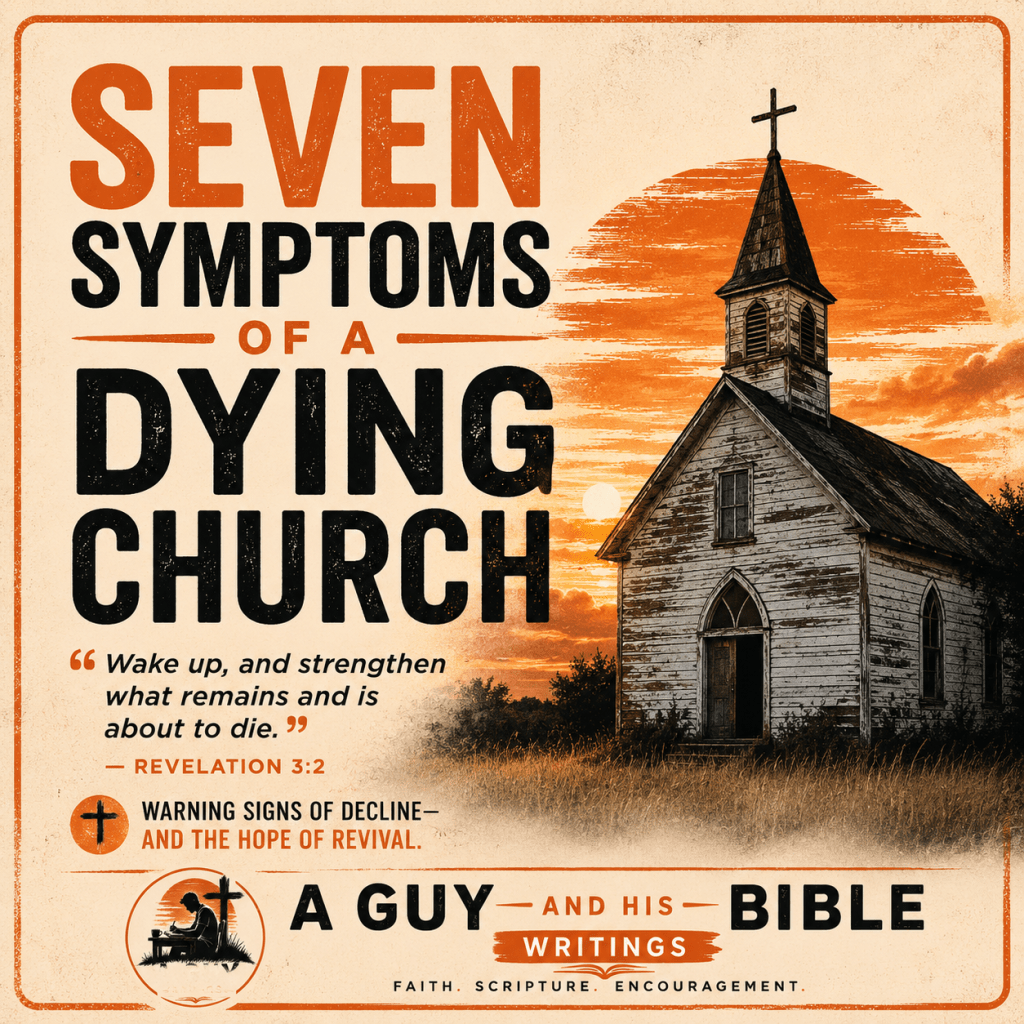
Churches rarely die suddenly. More often, they decline gradually as unhealthy attitudes, misplaced priorities, unresolved conflicts, and inward-focused traditions become accepted as normal.
At first, the warning signs may seem insignificant. Attendance begins to decline. Meetings become longer while ministry becomes less effective. Conflict becomes more common. The congregation spends more time protecting its history than preparing for its future. Before long, the church’s energy is focused almost entirely on maintaining what exists rather than reaching people with the Gospel.
Jesus gave a sobering warning to the church in Sardis:
“Wake up, and strengthen the things that remain, which were about to die.”
—Revelation 3:2
Although these words are serious, they are not without hope. Jesus did not tell the church that nothing could be done. He called them to wake up, strengthen what remained, remember what they had received, repent, and return to faithful obedience.
A struggling church is not necessarily a hopeless church. A dying church is never beyond the reach of the living Savior.
The following seven symptoms can help church leaders and congregations honestly evaluate their spiritual condition. The purpose is not to criticize churches or condemn people. It is to recognize warning signs early enough to pursue repentance, renewal, and revival.
1. Continuous Battles
One of the clearest symptoms of an unhealthy church is an atmosphere of ongoing conflict.
Every church will experience disagreements. Congregations are made up of people with different personalities, experiences, preferences, and opinions. Disagreement itself is not always a sign of spiritual decline. The problem begins when conflict becomes the culture rather than the exception.
In a dying church, arguments may develop over nearly everything:
- Music styles
- Leadership decisions
- Building usage
- Ministry schedules
- Decorating choices
- Financial priorities
- Changes to long-standing programs
- Who receives recognition
- Who is allowed to make decisions
Instead of working together to reach people, members begin fighting one another for control.
The church may still gather for worship, but bitterness exists beneath the surface. Conversations become political. People form groups and alliances. Rumors spread. Members assume the worst about one another, and every decision is interpreted through suspicion.
Scripture gives the church a very different standard:
“By this all people will know that you are My disciples: if you have love for one another.”
—John 13:35
A church known primarily for conflict is presenting a distorted picture of Jesus to its community.
Healthy churches do not avoid every disagreement. They learn to approach disagreement with humility, grace, truth, patience, and love. They remember that the mission of Christ is greater than personal preferences.
Questions to Consider
Is our church known for compassion or conflict?
Do our disagreements center on biblical truth, or are we fighting over personal preferences?
Are we seeking reconciliation, or are we trying to win arguments?
2. Numerical Decline for Three or More Years
Numbers are not the only measurement of a church’s health. A growing crowd does not automatically mean a spiritually healthy church, and a small congregation is not necessarily a failing congregation.
However, consistent numerical decline should not be ignored.
When attendance, baptisms, participation, giving, volunteer involvement, and community engagement decline year after year, the pattern may indicate deeper spiritual issues that require attention.
Leaders sometimes explain every decline by blaming cultural changes, population shifts, younger generations, or the community. Those factors may contribute, but a church must also be willing to ask difficult questions.
Are we actively sharing the Gospel?
Are we making disciples?
Are we welcoming new people?
Are we helping younger believers grow?
Are we serving the needs of our community?
Are we praying for lost people by name?
Are we equipping members to live as missionaries in their neighborhoods and workplaces?
Numerical decline should not produce panic, manipulation, or obsession with attendance statistics. It should lead to prayerful evaluation.
The goal is not simply to fill seats. The goal is to reach people, make disciples, baptize believers, teach Scripture, serve the community, and glorify Christ.
Questions to Consider
When was the last time someone came to faith in Christ through the ministry of our church?
Are new believers being discipled?
Are we actively inviting people into our church community?
Have we accepted decline as unavoidable instead of seeking God for renewal?
3. Rooms as Idols
Church buildings can be tremendous tools for ministry. They provide space for worship, discipleship, fellowship, outreach, counseling, community meals, children’s ministry, and countless other opportunities.
The problem begins when the building becomes more important than the mission.
In an unhealthy church, members may become more passionate about protecting rooms than reaching people. The congregation may be unwilling to adjust the use of the building because every classroom, piece of furniture, or decoration has become emotionally untouchable.
Statements such as these begin to dominate conversations:
- “That room has always been used for this.”
- “We cannot move that furniture.”
- “That classroom belongs to our group.”
- “We do not want children making a mess.”
- “The building might get damaged.”
- “We have never allowed the community to use that space.”
Stewardship matters. Churches should take care of the resources God has provided. However, stewardship does not mean preserving a building at the expense of ministry.
The building exists to support the mission. The mission does not exist to protect the building.
A church facility should be viewed as a tool entrusted to the congregation for worship, discipleship, outreach, hospitality, and service. When rooms become more valuable than people, the church has confused its priorities.
Questions to Consider
Do we see our building as a ministry tool or a museum?
Are we more concerned about preserving rooms than reaching families?
Would we be willing to rearrange, renovate, repurpose, or share our space if it helped us fulfill the Great Commission?
4. Memorials and Plaques
There is nothing wrong with remembering the faithfulness of previous generations. Churches should honor those who sacrificed, served, prayed, gave, taught, and laid the foundation for future ministry.
The danger comes when celebrating yesterday’s victories becomes more important than pursuing today’s opportunities.
A dying church often spends considerable time talking about what God used to do:
- “We used to fill every pew.”
- “We used to have a large youth ministry.”
- “We used to host major community events.”
- “We used to baptize people regularly.”
- “We used to have a powerful choir.”
- “We used to be the most influential church in the area.”
These memories can inspire faith, but they can also become excuses for inactivity.
God’s past faithfulness should encourage us to trust Him in the present. It should not cause us to live permanently in the past.
The previous generation fulfilled its assignment in its time. The current generation must do the same.
A church cannot reach today’s community by merely remembering yesterday’s ministry. The Gospel does not change, but methods, communication styles, community needs, and ministry opportunities often do.
The question is not simply, “What did God do here fifty years ago?”
The question is, “What does God want to do through us today?”
Questions to Consider
Are we celebrating the past while neglecting the future?
Do stories about former ministries inspire current obedience, or do they replace it?
Are we more interested in preserving a legacy than continuing the mission?
5. Prolonged Meetings
Another symptom of decline is the tendency to replace ministry with meetings.
Meetings can be necessary. Churches need to communicate, organize, plan, evaluate, and make decisions. However, meetings become unhealthy when endless discussion replaces prayer, action, evangelism, service, and disciple-making.
A church can spend hours discussing ministry without actually doing ministry.
Committees may debate small details while important opportunities are missed. Decisions are repeatedly delayed because someone wants more information, another meeting, another vote, or another discussion.
Eventually, the church develops a culture in which permission is difficult to receive and action is easy to prevent.
The congregation becomes excellent at discussing why something might not work but rarely asks how it could be accomplished.
A healthy meeting should produce clarity, responsibility, and action. People should leave knowing what needs to be done, who will do it, and when it will be completed.
Meetings should support the mission—not become the mission.
Questions to Consider
Are our meetings producing ministry or maintaining the status quo?
Do we spend more time discussing outreach than actually reaching people?
Are decisions delayed because of wisdom, or because we are afraid of change?
Could some meetings be shortened, combined, or eliminated?
6. Deflection of Blame
Dying churches often become skilled at identifying everyone responsible for the decline except themselves.
Members may blame:
- The pastor
- Previous pastors
- Church leadership
- Younger generations
- Older generations
- The surrounding community
- Changing culture
- Other churches
- The worship style
- The denomination
- The economy
- Families who stopped attending
Some of these concerns may contain truth. Leadership failures, cultural changes, and community conditions can affect a church. However, constant blame prevents honest repentance.
Revival begins when people stop pointing fingers and start looking in the mirror.
Instead of asking, “Who caused this?” we should ask, “How have I contributed to this condition?”
Instead of asking, “Why are people not coming?” we should ask, “Who have I personally invited?”
Instead of asking, “Why is no one serving?” we should ask, “Where am I serving?”
Instead of complaining that the church lacks prayer, generosity, evangelism, compassion, or unity, each member should consider whether those qualities are present in his or her own life.
Personal responsibility is essential to church renewal. We cannot repent for everyone else, but we can repent for ourselves.
Questions to Consider
Do we accept responsibility for our church’s spiritual condition?
Are we more willing to criticize than contribute?
Have we blamed others for responsibilities God has given to us?
What attitudes, habits, or actions do we personally need to change?
7. Methodological Stability
The final symptom is the belief that methods must never change.
In a declining church, the phrase “We have always done it this way” becomes more important than the question, “How can we reach people today?”
The Gospel must never be changed. Biblical truth is not subject to cultural opinion. The church must remain faithful to Scripture regardless of what becomes popular or unpopular.
However, the methods used to communicate the Gospel can change.
The early church did not have church buildings, websites, livestreams, sound systems, printed bulletins, social media accounts, or many of the programs churches now consider traditional. Methods have always developed according to available opportunities and the needs of the people being reached.
Faithfulness does not require a church to repeat every method used in the past.
A church can remain theologically faithful while changing:
- Service times
- Communication methods
- Outreach strategies
- Classroom arrangements
- Ministry schedules
- Discipleship structures
- Leadership processes
- Music selections
- Community partnerships
- Volunteer systems
Change should never be pursued merely for the sake of being modern. Every method should be evaluated biblically and prayerfully.
The most important question is not, “Is this the way we have always done it?”
The better question is, “Does this help us make disciples and reach people with the Gospel?”
Questions to Consider
Are we protecting traditions more than pursuing the Great Commission?
Have our methods become more important than our mission?
Are we willing to embrace biblical change when it helps us fulfill Christ’s calling?
Five Questions Every Church Should Ask
Church renewal requires honest evaluation. Leaders and members should prayerfully consider the following questions.
1. Are We Protecting Traditions More Than Pursuing the Great Commission?
Traditions can provide stability, identity, and meaningful connection to the past. However, traditions must never become more authoritative than Scripture or more important than reaching people.
Every tradition should be evaluated by asking whether it helps the church worship Christ, make disciples, serve people, and proclaim the Gospel.
2. Is Our Church Known More for Conflict or Compassion?
The surrounding community notices how church members treat one another. A congregation may have strong preaching, beautiful music, and excellent programs, but persistent conflict can destroy its witness.
The church should be known as a place where truth is spoken in love, broken people are welcomed, needs are met, relationships are restored, and Jesus is clearly proclaimed.
3. Are We Celebrating the Past While Neglecting the Future?
We should thank God for everything He has done through previous generations. But gratitude for the past should produce obedience in the present.
The church must continually ask how it can faithfully pass the Gospel to children, teenagers, young adults, families, and future generations.
4. Are Our Meetings Producing Ministry?
Every meeting should have a clear purpose. Discussions should lead to prayerful decisions, and decisions should lead to action.
A church should not spend months debating an opportunity that may disappear while it is still being discussed.
5. Would a Lost Person Recognize Our Passion for Jesus?
A visitor should encounter more than a schedule of religious activities. That person should see genuine love for Christ, compassion for people, commitment to Scripture, and urgency about the Gospel.
Our greatest message is not that our church is friendly, traditional, modern, large, small, or active. Our message is that Jesus saves.
Action Steps Toward Church Renewal
Recognizing the symptoms is only the beginning. The church must respond with humility, prayer, repentance, and obedience.
Pray for God to Reveal Inward-Focused Priorities
Church renewal begins with prayerful honesty.
Ask God to reveal attitudes, traditions, programs, or preferences that have become more important than His mission. This kind of prayer requires humility because God may expose areas we would rather defend.
The question is not simply whether the church has become inward-focused. The question is whether we are willing to change when God reveals it.
Ask God for a Fresh Burden for Lost People
Churches decline when they lose sight of people who do not know Christ.
We must ask God to give us compassion for our neighbors, coworkers, family members, friends, and community. Lost people should never become statistics or abstract ministry targets. They are individuals created in the image of God who need the hope of the Gospel.
A fresh burden for lost people will affect how the church prays, budgets, plans, serves, teaches, and measures success.
Evaluate Every Ministry
Every ministry should be evaluated by asking:
“How does this ministry help us make disciples and reach people with the Gospel?”
A ministry should not continue indefinitely simply because it has always existed. Programs are tools, not sacred institutions.
Some ministries may need to be strengthened. Others may need to be redesigned, combined, or concluded so that energy and resources can be directed toward more effective opportunities.
Evaluation is not disrespectful. It is responsible stewardship.
Replace Criticism With Prayer and Responsibility
Criticism is easy. Faithful service requires humility and effort.
Before criticizing a leader, ministry, volunteer, or decision, pray. Ask whether the concern should be addressed directly, graciously, and constructively.
Then consider what personal responsibility you can accept.
Do not merely say the church needs more volunteers—volunteer.
Do not merely say the church needs to pray more—begin praying.
Do not merely say the church should reach young people—build relationships with young people.
Do not merely say the church needs greater generosity—give generously.
Renewal begins when criticism gives way to prayerful participation.
Be Willing to Embrace Biblical Change
Change can be uncomfortable, especially when it affects traditions, routines, and familiar ministries.
However, the church must be willing to change anything that is not biblically essential if doing so helps fulfill Christ’s mission.
Biblical change does not abandon truth. It removes unnecessary barriers that prevent the church from communicating truth effectively.
The goal is not to become trendy. The goal is to become faithful, fruitful, and focused on Christ.
A Dying Church Is Not Beyond the Living Savior
The condition of some churches may appear hopeless. Attendance may be low. Resources may be limited. Conflict may have caused deep wounds. Leaders may feel discouraged, and members may be tired.
But the future of the church does not ultimately depend on buildings, budgets, programs, traditions, or personalities.
Our hope is Jesus Christ.
Jesus can restore broken relationships.
Jesus can renew spiritual passion.
Jesus can raise up new leaders.
Jesus can awaken a congregation that has become comfortable.
Jesus can give a church fresh compassion for its community.
Jesus can transform a church that is willing to humble itself, repent, pray, and obey.
Revival begins when God’s people stop defending unhealthy patterns and begin seeking His presence. It begins when personal preferences are surrendered to Christ’s mission. It begins when members care more about reaching the lost than protecting the familiar.
A dying church is never beyond the reach of a living Savior.
A Prayer for Church Renewal
Lord, revive Your church.
Reveal every place where we have become inward-focused. Forgive us for protecting our preferences more than pursuing Your mission. Forgive us for allowing conflict, fear, nostalgia, pride, and complacency to weaken our witness.
Renew our passion for Your glory. Give us a fresh burden for people who do not know Christ. Teach us to pray with faith, serve with humility, speak with grace, give with generosity, and obey with courage.
Help us honor the past without becoming trapped in it. Give us wisdom to preserve biblical truth while changing methods that no longer help us fulfill the Great Commission.
Replace criticism with responsibility, division with unity, inactivity with obedience, and fear with faith.
Wake us up. Strengthen what remains. Restore our love for Jesus, our commitment to the Gospel, and our desire to make disciples.
Use Your church to bring hope, healing, truth, and salvation to our community.
Lord, revive Your church. Amen.


 Patrick Ryan Lewis
Leave a comment