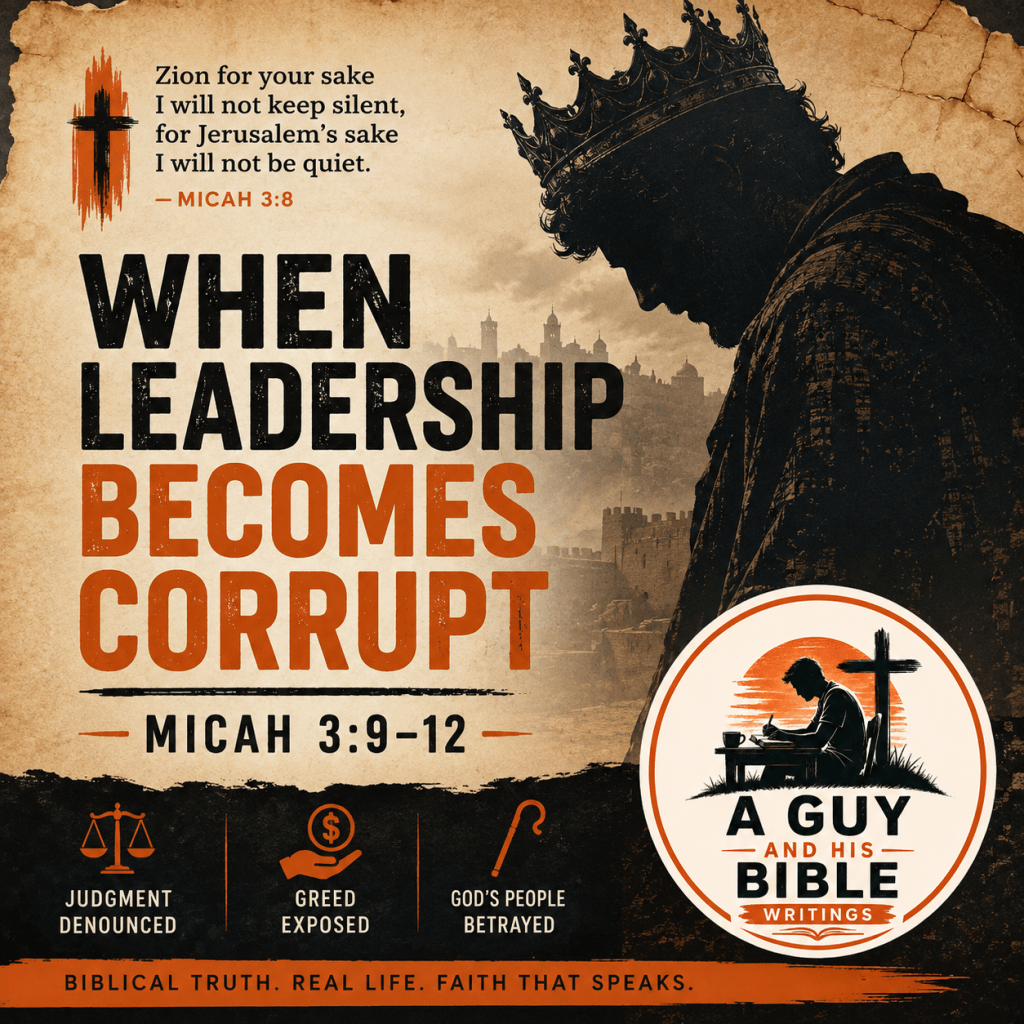
Micah 3 is not a comfortable chapter. It is a direct confrontation of leadership that had abandoned the responsibilities God had entrusted to it. Micah was not speaking primarily to people who openly rejected God. He was addressing rulers, priests, prophets, and others who occupied positions of influence among God’s people. These were people who knew the language of faith, lived within the covenant community, and in many cases carried religious authority. Yet their conduct stood in direct contradiction to the God they claimed to represent.
Micah describes Israel’s leaders as those “Who abhor justice / And twist everything that is straight” (Micah 3:9, LSB). Instead of protecting justice, they distorted it. Instead of using authority to serve the people, they used their positions for personal benefit. The rulers accepted bribes, priests allowed money to influence their instruction, and prophets practiced their ministry for financial gain. At every level of leadership, personal interest had begun replacing faithfulness to God.
The warning of Micah 3:9–12 reaches far beyond ancient Jerusalem. It forces us to consider the relationship between leadership, money, spiritual activity, accountability, and personal integrity. It also asks a more uncomfortable question: Can we become so confident in our religious identity that we assume God’s approval while ignoring areas of disobedience?
How Does Financial Corruption Damage Trust in Spiritual or Political Leadership?
Money itself is not presented in Scripture as inherently evil, nor does Micah condemn every leader who receives compensation. The problem is what happens when financial gain begins determining what leaders say, what they refuse to say, whom they favor, and how they make decisions.
Micah described rulers who pronounced judgment for bribes, priests who instructed for a price, and prophets who divined for money (Micah 3:11). These were not isolated failures. Corruption had spread throughout the leadership structure. Political, judicial, and religious leaders were all allowing self-interest to influence responsibilities that should have been governed by truth and justice.
Financial corruption is particularly destructive because leadership depends heavily upon trust. People need to believe that decisions are being made because they are right, not because someone stands to profit from them. When people begin wondering whether a decision, sermon, policy, recommendation, or judgment has been influenced by money, confidence in leadership begins to collapse.
The damage often extends beyond the individual leader. When a pastor behaves dishonestly with money, people may begin questioning the church. When a public official accepts bribes, people may begin distrusting government institutions. When a ministry repeatedly prioritizes revenue over truth, people can become cynical about Christian ministry itself.
God therefore cares about far more than what leaders say publicly. He cares about how they treat people, how they handle money, how they exercise authority, how they make decisions, whether they protect or exploit vulnerable people, and whether their private character agrees with their public message.
Leadership is never merely about having influence. Biblical leadership involves stewardship. Whatever authority, resources, opportunities, or influence God gives a person must ultimately be handled with the recognition that the leader remains accountable to God.
What Is the Difference Between Receiving Appropriate Support and Allowing Money to Control Ministry?
Micah 3 should not be interpreted as teaching that pastors, missionaries, teachers, or others involved in ministry should never receive financial support. Scripture teaches elsewhere that those who devote themselves to spiritual ministry may appropriately receive material support for their work (see 1 Corinthians 9:14 and 1 Timothy 5:17–18).
The problem in Micah was not simply that priests were paid or prophets received money. The deeper problem was that money had begun influencing their message and conduct.
There is an enormous difference between being supported so that you can faithfully serve and changing how you serve in order to maintain support.
That distinction remains important today.
A pastor can receive a salary without becoming controlled by money. A missionary can raise financial support without allowing donors to determine the truth he teaches. A Christian organization can carefully manage fundraising without turning ministry into a business in which financial success becomes more important than biblical faithfulness.
The danger begins when financial considerations determine obedience.
A pastor may become reluctant to address a biblical issue because an influential donor could become offended. A church may avoid difficult conversations because leadership fears losing members. A ministry may emphasize whatever generates the greatest response rather than what people most need to hear. A Christian leader may cultivate relationships primarily according to what someone can contribute financially.
At that point, money has moved from supporting ministry to controlling ministry.
Every Christian leader eventually encounters situations in which faithfulness carries a cost. The question is whether truth remains truth when telling it becomes expensive.
How Can Religious Activity Create a False Sense of Spiritual Security?
One of the most disturbing parts of Micah’s message is that these corrupt leaders still believed they enjoyed God’s protection.
Micah says they leaned upon Yahweh and confidently asked, “Is not Yahweh in our midst?” They concluded, “Evil will not come upon us” (Micah 3:11, LSB).
Their confidence was based on religious privilege rather than obedient faith.
Jerusalem was the center of Israel’s worship. The temple stood there. Sacrifices were offered there. Priests served there. God’s covenant promises were known there. Because these religious institutions remained in place, the leaders apparently believed Jerusalem was untouchable.
Their reasoning was essentially: We belong to God. We have God’s temple. We practice the correct religion. Therefore, judgment cannot reach us.
They confused God’s presence with God’s approval.
That distinction remains extremely important.
Religious activity can become spiritually dangerous when we begin treating it as evidence that everything between us and God must be right. Church attendance, biblical knowledge, ministry involvement, Christian vocabulary, theological education, charitable giving, and public service can all be good things. None of them, however, can substitute for repentance and obedience.
A person can know Scripture while refusing to obey what Scripture says. A person can attend church while harboring bitterness. Someone can lead Bible studies while behaving dishonestly at work. Someone can serve in ministry while mistreating family members. A person can publicly defend biblical morality while privately living without accountability.
Religious activity should draw us toward obedience. It should never become a hiding place from obedience.
What Might It Look Like Today to Assume God Approves of Us Simply Because We Attend Church or Participate in Ministry?
Micah’s leaders possessed something very similar to what we might call spiritual presumption. They assumed that their relationship with religious institutions guaranteed God’s approval.
Modern Christians can fall into the same trap.
We might think, I attend church every Sunday, so I must be doing well spiritually. We might believe that serving on a ministry team, giving money, knowing theology, teaching Scripture, or holding a leadership position proves that our relationship with God is healthy.
None of those things are meaningless. They can be important expressions of genuine faith. The danger comes when we use them to avoid examining the rest of our lives.
Perhaps someone serves faithfully at church but continually lies in business. Perhaps someone teaches Scripture publicly but refuses to apologize when wrong. Perhaps someone gives generously but treats employees harshly. Perhaps someone talks frequently about grace but refuses to forgive. Perhaps someone leads others spiritually while refusing meaningful accountability personally.
Micah reminds us that God is not impressed by religious activity that exists alongside persistent, unrepentant disobedience.
The question is not merely, What Christian activities am I participating in?
The deeper question is, Is my life being brought under the authority of the God I claim to worship?
How Can Churches Develop Accountability Without Creating an Atmosphere of Suspicion?
Micah’s warning shows what can happen when leaders operate without meaningful accountability. Power becomes dangerous when nobody is permitted to ask questions.
Healthy accountability, however, does not require assuming everyone is dishonest. There is a significant difference between accountability and suspicion.
Suspicion begins with the assumption that someone is probably doing something wrong. Accountability recognizes something different: every human being is capable of making poor decisions, becoming prideful, developing blind spots, or misusing influence.
Biblical accountability therefore protects both leaders and the people they serve.
Churches can develop healthy accountability by ensuring that financial decisions are transparent, significant decisions involve multiple qualified people, leaders remain answerable to other leaders, and concerns can be raised without fear of retaliation. No pastor, elder, staff member, board member, ministry leader, or influential donor should function as though questioning a decision is equivalent to rebellion.
Leaders should actually welcome appropriate accountability.
A leader who knows that his motives, decisions, finances, and conduct can be appropriately examined has an additional safeguard against temptation. Accountability should not merely exist to catch people doing wrong. It should help people remain faithful before wrongdoing occurs.
Healthy churches create cultures where questions can be asked respectfully, correction can be received humbly, mistakes can be admitted openly, and repentance can be celebrated rather than concealed.
What Responsibilities Do Followers Have When Leaders Behave in Ways That Contradict Scripture?
Micah demonstrates that God’s people cannot assume leaders are automatically correct simply because they possess authority.
Leadership deserves appropriate respect, but human authority is never absolute. God’s Word remains the final standard by which teaching and conduct must be evaluated.
Followers therefore have a responsibility to know Scripture themselves. Without biblical knowledge, people can easily mistake charisma for character, confidence for truth, popularity for God’s blessing, or authority for spiritual maturity.
When leaders behave in ways that clearly contradict Scripture, Christians should respond with wisdom rather than gossip, hostility, or blind loyalty. Depending upon the situation, that may involve asking questions, approaching the leader personally, following established accountability structures within the church or ministry, involving additional qualified leaders, or refusing to participate in conduct that violates Scripture.
Serious wrongdoing should not be protected merely because exposing it might embarrass an institution.
Protecting the reputation of a ministry can never become more important than protecting people or honoring Christ.
At the same time, accusations should be handled carefully and fairly. Biblical accountability requires both courage and integrity. We should neither ignore legitimate wrongdoing nor participate recklessly in rumors and unverified accusations.
Our ultimate loyalty belongs to Christ.
What Religious Activities or Identities Might We Trust Instead of Genuine Obedience to God?
Micah 3:12 contains the devastating conclusion to the prophet’s warning. Jerusalem’s leaders believed their city was protected because God’s temple stood there. Micah announced the opposite.
Because of their corruption, “Zion will be plowed as a field” (Micah 3:12, LSB). Jerusalem would become ruins, and the mountain associated with the house of God would become desolate.
The institution they believed guaranteed their security would not protect them from God’s judgment.
Christians should hear the warning clearly.
We can place our confidence in denominational identity, church membership, baptism, ministry positions, theological knowledge, years of Christian service, generosity, family heritage, or association with respected Christian leaders.
Again, these things can have value. The problem comes when we allow them to replace present obedience.
We should never say in our hearts, I have been a Christian for thirty years, so God cannot seriously challenge me. We should never assume, I am a pastor, teacher, volunteer, missionary, donor, or ministry leader, therefore my spiritual condition must be healthy.
The Christian life is not ultimately measured by the religious titles we possess but by whether we continue trusting, following, and obeying Christ.
What Does This Passage Teach Us About the Relationship Between Privilege and Responsibility?
Israel’s spiritual privileges did not reduce its responsibility before God. They increased it.
Israel had received God’s law. They had experienced His promises. They had His covenant. They had prophets who repeatedly called them back to faithfulness. Jerusalem possessed the temple, which represented God’s unique covenant relationship with His people.
They had received extraordinary spiritual privilege.
That privilege created extraordinary responsibility.
The same principle should cause Christians today to examine what God has entrusted to us. Those who have access to Scripture carry responsibility for what they learn. Those who have experienced years of faithful biblical teaching carry responsibility for how they respond to that teaching. Those entrusted with leadership carry greater responsibility because their decisions affect other people. James 3:1 gives a particularly serious warning concerning those who teach because teachers face stricter judgment.
The question therefore should not merely be, How much has God given me?
We should also ask, What am I doing with what God has given me?
Knowledge brings responsibility. Influence brings responsibility. Opportunity brings responsibility. Leadership brings responsibility. Spiritual privilege should produce greater humility, obedience, gratitude, and faithfulness—not greater entitlement.
Why Should God’s Patience Lead Us Toward Repentance Rather Than Complacency?
One of the easiest mistakes to make spiritually is interpreting the absence of immediate consequences as evidence that everything must be fine.
Micah’s audience had apparently been living with corruption for some time. Judgment had not arrived immediately. Jerusalem still stood. The temple still functioned. Religious ceremonies continued.
That delay could easily have been interpreted as approval.
But God’s patience is not permission.
Romans 2:4 teaches that God’s kindness and patience are intended to lead people toward repentance. When God does not immediately bring consequences for sin, His patience should move us toward humility and change rather than encouraging us to continue.
We should therefore be very careful about thoughts such as, Nothing has happened yet, so perhaps this isn’t that serious.
Perhaps the dishonest business practice continues producing money. Perhaps the hidden sin remains undiscovered. Perhaps the unhealthy leadership pattern has not caused a public crisis. Perhaps the compromised relationship has not collapsed. Perhaps years have passed without visible consequences.
None of that transforms disobedience into obedience.
God’s patience gives us time to repent. We should receive that patience as mercy.
In What Area of Influence Do You Need Greater Integrity?
Micah’s message ultimately becomes personal.
Most of us have some area of influence. You may lead a church, ministry, organization, business, household, classroom, team, Bible study, volunteer group, or simply influence friends and family.
The question is not whether you have the largest platform.
The question is whether you are faithful with the influence you already possess.
Are you the same person privately that you appear to be publicly? Do you keep your word? Do you handle money honestly? Do you admit mistakes? Do you use authority to serve others or to protect yourself? Can people question you without fearing your reaction? Are there standards you expect others to follow while quietly exempting yourself?
Integrity means that our beliefs, words, and behavior increasingly agree with one another.
The leaders of Micah’s day experienced the opposite. Their public religious identity and private motivations had become disconnected.
Micah’s warning calls us back to wholeness.
Is There a Truth You Have Been Avoiding Because Obedience Could Be Costly?
This may be one of the most difficult questions raised by the passage.
Micah spoke truth to powerful people. His message would not have been popular because it challenged leaders who had benefited from the existing system.
Faithfulness sometimes costs something.
Perhaps obedience means admitting you were wrong. Perhaps it means having a difficult conversation you have repeatedly postponed. Perhaps it means refusing money attached to inappropriate conditions. Perhaps it means confronting an unhealthy leadership practice. Perhaps it means telling the truth when silence would be more comfortable. Perhaps it means changing a business practice, ending a compromising relationship, confessing hidden sin, establishing accountability, or surrendering an ambition that has become more important than obedience.
We often discover what truly controls us when obedience becomes expensive.
The question is not simply whether we know what Scripture teaches.
The question is whether we are willing to obey when obedience costs us something.
What Specific Action Can You Take This Week in Response to This Passage?
Micah 3 should not remain merely an interesting study of corrupt leadership in ancient Israel.
Scripture calls for response.
Perhaps your next step is financial transparency. Perhaps you need to apologize to someone you have mistreated. Perhaps you need to invite someone trustworthy to hold you accountable. Perhaps you need to speak about a problem you have ignored. Perhaps you need to stop participating in something you know is wrong. Perhaps you need to examine whether money, approval, reputation, comfort, or influence has begun affecting decisions that should be governed by Scripture.
Do not allow conviction to remain vague.
Identify one concrete act of obedience.
Write it down. Tell someone you trust. Pray about it. Then do it.
A Closing Challenge: God’s Presence Is Not the Same as God’s Approval
The leaders of Jerusalem were confident because they believed Yahweh was among them. They had the temple, the priests, the prophets, and the language of faith.
What they lacked was obedience.
Micah’s warning is therefore especially important for religious people.
We should never allow familiarity with Christianity to replace faithfulness to Christ. We should never use church attendance to hide from repentance, ministry service to compensate for compromised character, biblical knowledge to excuse pride, or spiritual privilege to create a false sense of security.
God cares about what happens behind our public Christianity.
He cares about how we use money. He cares about how we treat people. He cares about what we do with authority. He cares about whether we defend the vulnerable. He cares about our motives. He cares about our private decisions. He cares about whether the truth we proclaim publicly is shaping the life we live privately.
Micah 3:9–12 reminds us that leadership without integrity eventually becomes destructive, spiritual privilege brings greater responsibility, and God’s patience should always lead us toward repentance.
So the final question is not simply, What was wrong with Israel’s leaders?
It is much closer to home:
What has God entrusted to me, and am I handling it faithfully?


 Patrick Ryan Lewis
Leave a comment