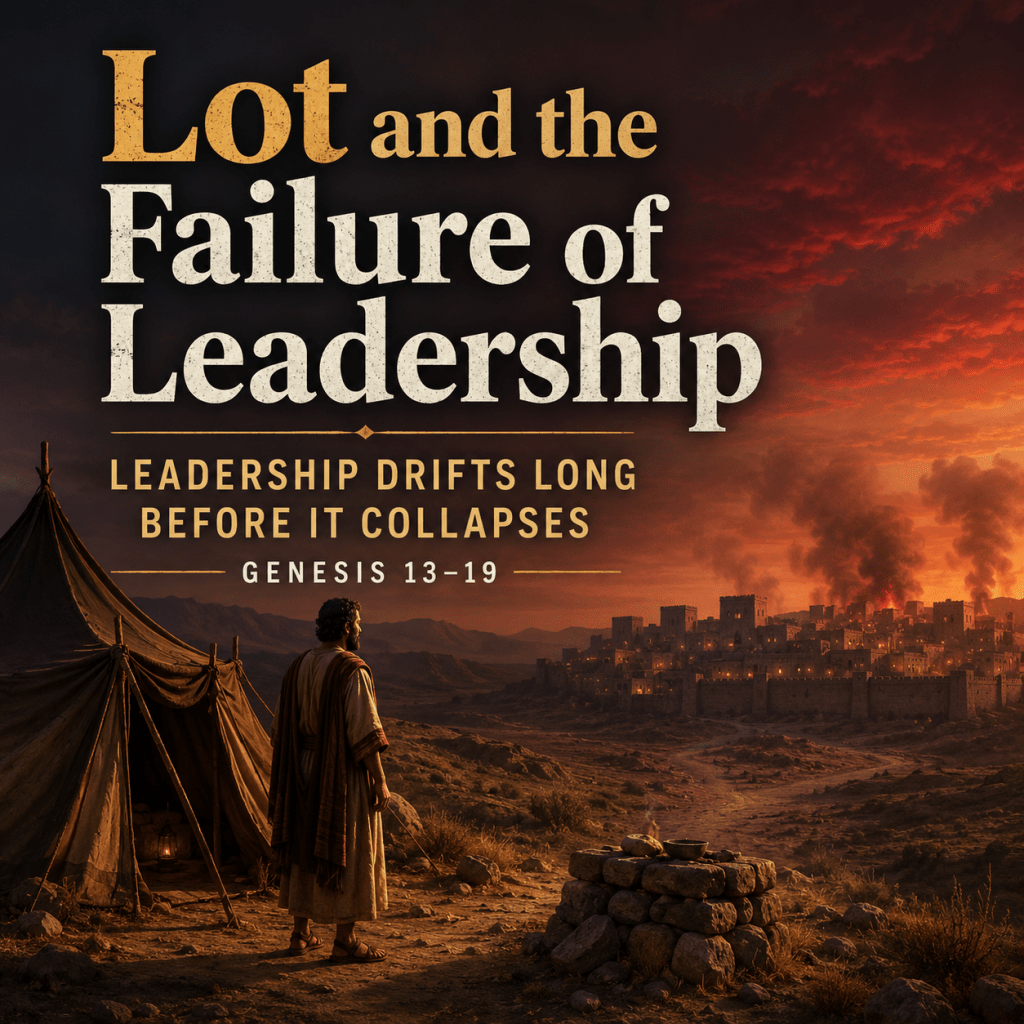
Primary Text: Genesis 13–19
Theme: Leadership drifts long before it collapses.
Leadership failures rarely begin with one sudden, catastrophic decision. They usually begin quietly—with a small compromise, a gradual adjustment, or a step toward something that once caused concern.
That is what we see in the life of Lot.
Lot did not wake up one morning and decide to destroy his influence, weaken his family, and lose nearly everything he had built. His collapse began much earlier, when he chose to settle near the border of Sodom.
His story gives us a sobering warning: leadership drifts long before it collapses.
The First Step: Settling Near the Border
“So Lot chose for himself all the vicinity of the Jordan, and Lot journeyed eastward. So they separated from each other. Abram settled in the land of Canaan, while Lot settled in the cities of the vicinity of the Jordan, and moved his tents as far as Sodom.”
—Genesis 13:11–12
Notice the progression in Lot’s decision:
- He looked.
- He chose.
- He moved toward.
- He pitched his tents near.
Lot did not immediately move into Sodom. He settled near it. He chose the border.
This is often how compromise begins. We convince ourselves that we are not participating in sin—we are merely getting close to it. We are not joining the culture; we are only living beside it. We are not abandoning our convictions; we are simply becoming more flexible.
Lot looked at the land surrounding Sodom and saw opportunity. It was fertile, attractive, profitable, and comfortable.
However, Lot does not appear to have asked the most important questions:
- Will this place help my family follow God?
- What kind of influence will shape my home?
- Will living here strengthen or weaken my spiritual leadership?
Lot evaluated the land economically, but he failed to evaluate it spiritually.
Leadership Lesson #1: Failure Begins With Proximity to Compromise
There is an important difference between reaching people who are far from God and placing ourselves under influences that gradually pull us away from Him.
Lot prioritized prosperity over purity. He chose what appeared beneficial without discerning what was spiritually dangerous.
Leadership that continually prioritizes comfort, profit, popularity, or opportunity over faithfulness will eventually lose far more than it gains.
This raises an important question for every Christian: Just because we can do something, does that mean we should?
Christian leadership is not merely about asking whether something is technically permissible. It is about asking whether it is wise, God-honoring, and beneficial to those we have been called to lead.
From the Border to the Gate
“Now the two angels came to Sodom in the evening as Lot was sitting at the gate of Sodom.”
—Genesis 19:1
By Genesis 19, Lot is no longer living near Sodom. He is sitting at the gate of Sodom.
In ancient cities, the gate was more than an entrance. It was a place where civic leaders, elders, and respected members of the community conducted business and settled disputes.
Lot did not merely move closer to Sodom. He integrated himself into it.
He did not simply live there. He became a leader there.
The man who once traveled with Abraham was now a civic figure in one of the most wicked cities on earth.
There is nothing inherently wrong with Christians serving in positions of social or civic leadership. Believers should bring truth, integrity, justice, and compassion into every area of society.
However, our responsibility as heralds of God must never be placed beneath our desire for social acceptance, community standing, or political influence.
Lot gained a seat at Sodom’s gate, but he lost the ability to lead Sodom toward righteousness.
Leadership Lesson #2: You Eventually Become Comfortable With What You Once Only Tolerated
Sin rarely demands complete surrender at the beginning.
It usually begins by inviting gradual adjustment.
- Lot adjusted his address.
- Then he adjusted his associations.
- Then he adjusted his affections.
- Eventually, his influence was compromised.
What once troubled him became normal. What once seemed dangerous became familiar. What once stood outside his home eventually shaped everything inside it.
Repeated exposure to compromise can dull our spiritual sensitivity. We begin by tolerating what is wrong, continue by excusing it, and eventually reach the point where we barely notice it.
A Leader Without Influence
When the angels warned Lot that Sodom was about to be destroyed, Lot attempted to warn his family.
“So Lot went out and spoke to his sons-in-law, who were to marry his daughters, and said, ‘Up, get out of this place, for the Lord is destroying the city.’ But he appeared to his sons-in-law to be joking.”
—Genesis 19:14
This is one of the most devastating moments in Lot’s story.
Lot was a father.
He was a spiritual leader in his home.
He knew the truth about God.
Yet when he finally spoke with urgency, no one took him seriously.
His sons-in-law thought he was joking.
Why?
Lot had lived so long blended into Sodom that when he finally spoke about judgment, holiness, and obedience, his words sounded absurd.
Perhaps they had never heard him speak with that kind of conviction before. Perhaps his lifestyle had communicated a very different message. Whatever the reason, when the moment came for Lot’s voice to carry spiritual weight, his credibility was gone.
Leadership Lesson #3: Compromised Living Destroys Spiritual Credibility
Our words carry weight when our lives support them.
No leader is perfect. Every parent, pastor, ministry leader, and Christian will stumble. Spiritual credibility does not require sinless perfection, but it does require visible integrity, humility, repentance, and consistency.
When our public words continually contradict our private conduct, people eventually stop listening.
A warning about compromise will not sound convincing when it comes from someone who has spent years embracing it.
A call to obedience will not carry much weight when it comes from someone known for hesitation.
A message about holiness will seem hollow when our lives are indistinguishable from the culture around us.
Lot knew the truth, but his compromised lifestyle had weakened his ability to communicate it.
Hesitation When It Mattered Most
“But he hesitated. So the men grasped his hand and the hand of his wife and the hands of his two daughters, because the compassion of the Lord was upon him; and they brought him out and put him outside the city.”
—Genesis 19:16
God had made the danger clear. The angels had warned Lot that destruction was coming.
Yet Lot lingered.
The angels had to seize him by the hand and pull him out of the city.
The man who once traveled with Abraham by faith now had to be dragged to safety.
Why was leaving so difficult?
Lot had invested his life in Sodom. His relationships were there. His reputation was there. His possessions were there. His position was there. His identity had become connected to the city.
Leaving Sodom meant losing everything he had built.
Leadership Lesson #4: When Compromise Roots Deeply, Obedience Becomes Painful
The deeper compromise grows, the harder obedience feels.
A decision that would have been simple years earlier becomes agonizing after our relationships, resources, reputation, and identity become entangled with disobedience.
Compromise always demands a higher price at the end than it promised at the beginning.
At first, Sodom appeared to offer Lot prosperity. In the end, it cost him his home, his possessions, his influence, his wife, and the spiritual health of his family.
Sin always presents the immediate benefit while hiding the eventual cost.
- It promises freedom but produces bondage.
- It promises comfort but creates sorrow.
- It promises acceptance but destroys identity.
- It promises gain but leaves devastation behind.
A Family Marked by His Choices
Lot escaped Sodom, but the consequences of his leadership followed him.
His wife looked back and became a pillar of salt.
His daughters had been so deeply influenced by the culture of Sodom that their thinking became spiritually confused and morally distorted.
Lot’s legacy was fractured.
The New Testament describes Lot as a righteous man who was distressed by the lawless conduct around him. Peter writes that God rescued “righteous Lot” from Sodom.
Lot belonged to God, but he still led poorly.
Leadership Lesson #5: You Can Be Personally Saved and Still Lead Poorly
Salvation does not make our choices inconsequential.
God’s grace forgives sin, but forgiveness does not always remove every earthly consequence of our decisions.
Lot was delivered, but he lost almost everything.
He escaped the judgment of Sodom, but his family had already absorbed its values.
This should sober every Christian leader. A person may genuinely belong to God while still making decisions that damage a family, weaken a ministry, or compromise a legacy.
Being righteous before God does not remove our responsibility to lead with wisdom, courage, and discernment.
The Core Problem: Vision Without Discernment
Genesis 13 tells us that Lot “raised his eyes” and saw the well-watered plain surrounding Sodom.
- Lot had vision, but he lacked discernment.
- He saw prosperity, but he did not see danger.
- He saw opportunity, but he did not see influence.
- He saw fertile land, but he did not see what that culture might do to his family.
This is what happens when leaders evaluate decisions only by what they can see.
Not every open door comes from God.
Not every profitable opportunity is spiritually beneficial.
Not every successful decision is a faithful one.
Something can make sense financially and still be disastrous spiritually. It can increase our influence while weakening our integrity. It can improve our social position while damaging our home.
Leadership is not merely about choosing what looks good. It is about choosing what honors God.
The Contrast Between Lot and Abraham
Lot chose what looked best to him.
Abraham trusted God to choose.
Lot moved toward Sodom.
Abraham built altars.
Lot became increasingly integrated with the culture around him.
Abraham maintained his identity as a man who belonged to God.
Abraham was not perfect, but the direction of his life was toward worship, dependence, and faith.
Lot’s direction was toward comfort, integration, and compromise.
The difference between these two men was not merely geography. It was spiritual direction.
One kept building altars.
The other kept moving his tent toward Sodom.
Where Are You Settling?
Lot’s story calls us to ask difficult questions.
- Are you living near spiritual compromise?
- Are you tolerating something that once troubled your conscience?
- Are you building influence in places that are weakening your family?
- Have comfort, prosperity, popularity, or social acceptance become more important than faithfulness?
- Have your words lost credibility because your life no longer supports them?
- If judgment came, would the people closest to you take your spiritual warnings seriously?
Leadership failure does not begin with catastrophe.
It begins at the border.
It begins when we move our tents closer to something God warned us about. It begins when we tolerate what we should confront. It begins when we protect our comfort more fiercely than our convictions.
The Gospel Contrast
Lot’s story reveals the failure of human leadership, but the gospel points us toward a better Leader.
Lot clung to Sodom.
Christ left heaven.
Lot lingered when God called him to leave.
Jesus obeyed the Father completely.
Lot attempted to preserve the life he had built.
Jesus willingly laid His life down.
Lot compromised with the culture around him.
Jesus remained faithful through every temptation.
Where Lot hesitated, Christ surrendered.
Where Lot compromised, Christ stood firm.
Where Lot’s leadership brought confusion to his family, Christ’s leadership brings salvation to His people.
Because Jesus stood firm, compromised leaders like us can be forgiven, restored, and transformed.
Our failures do not have to be the final chapter of our story. Through Christ, we can repent, rebuild, and lead differently.
Do Not Settle at the Border
Do not pitch your tent near what can destroy your home.
Do not exchange spiritual authority for social acceptance.
Do not sacrifice your family’s spiritual health for temporary comfort.
Move the tent away.
Build the altar again.
Reclaim your spiritual credibility.
Lead with conviction.
Lead with discernment.
Lead with a life that supports the truth you proclaim.
Because when we refuse to create distance from Sodom, Sodom will eventually shape us.
Leadership drifts long before it collapses. Therefore, do not wait for catastrophe before you act.
Turn around at the border.


 Patrick Ryan Lewis
Leave a comment