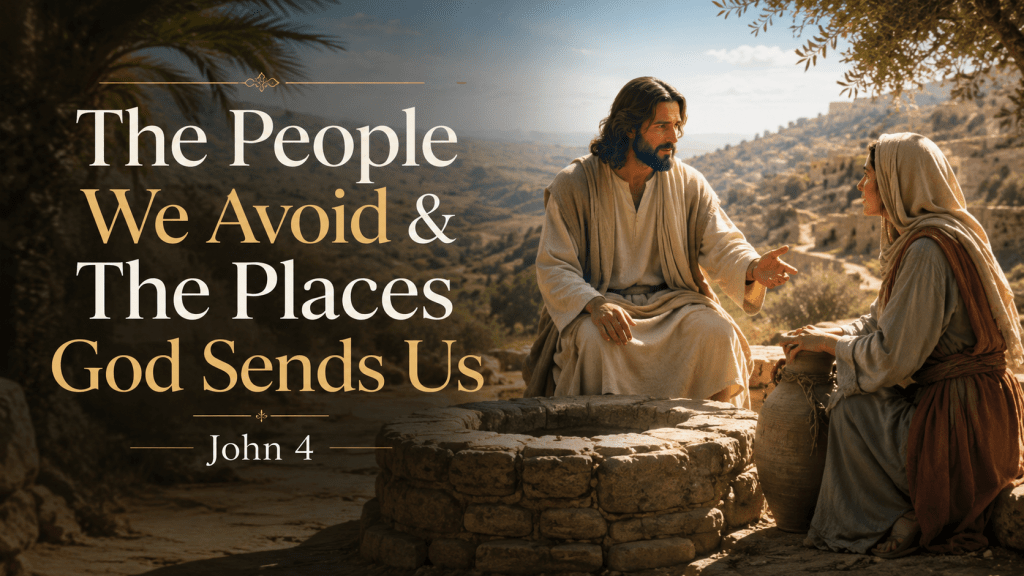
Primary Scripture: John 4
There are certain people we naturally move toward—and others we instinctively avoid.
Sometimes we avoid someone because of what they believe. Sometimes it is because of how they live, what they have done, or how they have treated us. We may assume they would never listen, that they are too far gone, or that reaching them would require more patience and grace than we are willing to give.
We may never say it aloud, but our actions reveal what we believe:
“They are not my kind of people.”
“They made their choices.”
“They would never listen to me.”
“That situation is too complicated.”
However, there is a serious spiritual danger hidden inside this kind of avoidance. When we continually avoid the people God is sending us to, we may eventually find ourselves avoiding the will of God altogether.
John 4 is often remembered as the story of the Samaritan woman at the well. But it is also the story of a Savior who refused to avoid the people whom others rejected.
Jesus entered the place others avoided, spoke to the person others overlooked, and revealed that God’s harvest was already waiting.
Why Did Jewish People and Samaritans Avoid One Another?
To understand the significance of John 4, we need to understand some of the history behind the hostility between the Jewish people and the Samaritans.
Following the reign of Solomon, the nation of Israel divided into two kingdoms. The northern kingdom retained the name Israel, while the southern kingdom became known as Judah. Samaria eventually became the capital of the northern kingdom.
In the eighth century BC, the Assyrian Empire conquered the northern kingdom. Many Israelites were deported, and other populations were resettled in the region. The exact development of the Samaritan community is historically complex. Samaritans understood themselves as descendants of the ancient Israelite tribes—particularly Ephraim, Manasseh, and Levi—while many Jewish people questioned the purity and legitimacy of their ancestry and worship.
Modern scholarship cautions against viewing the two communities as completely unrelated. Jews and Samaritans shared Israelite roots, honored the Torah, and developed with many similarities before becoming increasingly divided.
One of the greatest points of conflict concerned the proper place of worship. Jewish worship centered on the temple in Jerusalem. Samaritans believed Mount Gerizim, near Shechem, was God’s chosen place of worship. Each community considered itself the faithful continuation of biblical Israel.
A Samaritan temple was constructed on Mount Gerizim and was later destroyed by the Jewish Hasmonean ruler John Hyrcanus during the late second century BC. That destruction deepened the political and religious hostility that already existed between the communities.
By the time of Jesus, the division had existed for generations. It was not merely a personal disagreement. It involved ancestry, theology, worship, politics, prejudice, and centuries of painful history.
That is what makes John’s statement so striking:
“He had to travel through Samaria.” —John 4:4 CSB
Jesus willingly entered the middle of a division that others had learned to avoid.
1. Jesus Went Where Others Would Not Go
Jesus left Judea and began traveling toward Galilee. Samaria stood between the two regions. Although traveling through Samaria was a direct route, some Jewish travelers chose a longer route that allowed them to bypass Samaritan territory.
Jesus did not take the route of avoidance.
John tells us that He “had to” travel through Samaria. This language points to something greater than geographical necessity. Jesus was following a divine assignment.
There was a woman in Samaria who needed living water. There was a village waiting to hear the truth. There was a harvest the disciples could not yet see.
What others avoided, Jesus intentionally entered.
This raises a personal question for every follower of Christ:
Where is your Samaria?
Who have you gone out of your way to avoid?
Perhaps it is a coworker who mocks your faith, a relative who wounded you, a neighbor whose life is complicated, or someone whose worldview is completely different from your own.
Following Jesus will sometimes take us into uncomfortable conversations and unfamiliar places. Christian obedience cannot be limited to people who already think, vote, worship, behave, or live exactly like us.
We cannot claim to be following Jesus while refusing to go near the people Jesus loves.
2. Jesus Engaged the Person Others Rejected
Jesus arrived at Jacob’s well near the Samaritan town of Sychar. Tired from the journey, He sat beside the well around noon.
A Samaritan woman came to draw water, and Jesus spoke first:
“Give me a drink.” —John 4:7 CSB
This simple request crossed several boundaries.
He was Jewish, and she was Samaritan. He was a man speaking publicly with a woman. He was a respected teacher engaging someone whose personal life was complicated and painful.
The woman immediately recognized how unusual the conversation was. She asked why a Jewish man would request a drink from a Samaritan woman. John explains that Jewish people did not normally associate with Samaritans.
Jesus was not concerned about protecting His reputation at the expense of reaching a person.
He saw her.
He spoke to her.
He listened to her questions.
He revealed the truth about her life.
He offered her living water.
John 4 tells us that the woman had been married five times and was then living with a man who was not her husband. Scripture does not provide every detail behind her history, so we should be cautious about assuming everything that had happened to her. What is clear is that Jesus knew her story completely.
He did not ignore the truth about her life, but neither did He treat her past as a reason to reject her.
Jesus demonstrated grace without compromising truth and truth without withholding grace.
Sometimes we do not avoid people because they are unreachable. We avoid them because their lives make us uncomfortable.
Their history is messy.
Their questions are difficult.
Their pain is inconvenient.
Their beliefs challenge us.
Their needs may require time, compassion, and patience.
But Jesus did not wait for a comfortable ministry opportunity. He stepped into discomfort for the sake of redemption.
The gospel was never meant to remain in comfortable places.
3. Jesus Offers Living Water
The woman came to the well because she was physically thirsty. Jesus used that ordinary need to reveal a deeper spiritual reality.
He told her that ordinary water would satisfy her temporarily, but the water He offered would become a spring within her, producing eternal life. See John 4:10–14.
Like the Samaritan woman, we often attempt to satisfy spiritual thirst with temporary things.
We look to relationships to make us feel complete. We pursue success hoping it will make us significant. We seek approval because we want to feel valuable. We turn to entertainment, possessions, pleasure, work, or religious activity hoping they will quiet the emptiness inside us.
But temporary wells cannot satisfy an eternal thirst.
Jesus was offering more than a better life. He was offering Himself.
Living water is not earned through religious performance. It is received through faith in Christ. Jesus knows our complete history, sees every failure, and still invites us to receive the salvation only He can provide.
The woman came carrying an empty water jar, but her deepest emptiness could only be filled by Jesus.
The same is true for us.
4. Avoiding God’s Assignment Leaves Us Empty
While Jesus spoke with the woman, His disciples had gone into town to purchase food.
They entered the same community Jesus entered, but they did not yet see the same spiritual opportunity.
They saw a place to buy lunch. Jesus saw a field ready for harvest.
When the disciples returned, they urged Jesus to eat. Jesus answered:
“My food is to do the will of him who sent me and to finish his work.” —John 4:34 CSB
Jesus was teaching them that obedience to the Father brought a satisfaction deeper than physical food.
The disciples were focused on what they could consume. Jesus was focused on the mission He had been given.
This is where the passage becomes deeply personal.
When we are not where God wants us to be, we may remain busy while feeling spiritually empty. We may fill our calendars but lack purpose. We may consume more and more while never feeling satisfied.
Obedience does not always make life easier, but it places us where genuine spiritual fulfillment is found.
We can be in the correct place physically and still be completely out of position spiritually.
The disciples were standing beside Jesus, but they were not yet seeing what Jesus saw.
5. One Person Can Spark a Harvest
After encountering Jesus, the woman left her water jar beside the well and returned to town.
She told the people:
“Come, see a man who told me everything I ever did.” —John 4:29 CSB
She came to the well looking for water.
She left carrying a mission.
She did not have formal theological training. She could not answer every question. She had not yet worked through every detail of her past. She simply told others what Jesus had done and invited them to meet Him for themselves.
Her testimony was simple: Jesus knew her completely, and yet He still offered her grace.
Many Samaritans from the town believed because of her testimony. Others came to Jesus, listened to His words, and believed for themselves. By the end of the passage, people who might have been overlooked by the disciples recognized Jesus as the Savior of the world. See John 4:39–42.
The person others may have rejected became the person God used to reach an entire community.
Never underestimate what God can do through one honest testimony and one obedient conversation.
The person you are tempted to overlook may become the person God uses to reach a family, a workplace, a neighborhood, or a church.
What if the breakthrough you have been praying for is connected to the conversation you keep postponing?
What if healing in your family begins when you stop avoiding someone?
What if God has already prepared a heart, but He is waiting for you to speak?
6. The Harvest Is Ready, but We Are Often Selective
Jesus challenged His disciples:
“Open your eyes and look at the fields, because they are ready for harvest.” —John 4:35 CSB
The problem was not that God had failed to prepare the harvest.
The problem was that the disciples had not opened their eyes.
They had entered the Samaritan town and returned with food, but apparently they had not imagined that the people there might be ready to encounter the Messiah.
We often make the same mistake.
We decide who is interested before speaking.
We determine who is worthy before serving.
We assume who will respond before inviting.
We categorize people according to appearance, reputation, politics, background, addiction, income, education, or past mistakes.
Meanwhile, Jesus tells us to open our eyes.
The harvest may be waiting in the person who frustrates us. It may be found in the community we have ignored. It may begin with a conversation that feels awkward or inconvenient.
The gospel is not limited by a person’s condition. Too often, its proclamation is limited by our willingness.
Who Are You Avoiding?
Jesus went where others would not go.
He spoke to someone others would not speak to.
He loved someone others had learned to dismiss.
Because He did, a woman encountered the Messiah and a Samaritan community came to believe that Jesus was the Savior of the world.
So the question remains:
Who are you avoiding?
- Whose name immediately came to your mind?
- Whose face do you keep pushing away?
- Which conversation have you continued to postpone?
- What opportunity have you ignored because it would require you to leave your comfort zone?
That person may be part of your assignment.
That uncomfortable place may be your Samaria.
God is not asking us to approve of everything people do or pretend that sin does not matter. Jesus did neither of those things. He is calling us to carry truth with grace, enter difficult places with humility, and see people as individuals created in the image of God.
Stop Avoiding and Start Obeying
What might happen if we stopped avoiding and started obeying?
What if our prayer became:
- “God, send me where I would not naturally choose to go.”
- “Help me see the people I have overlooked.”
- “Give me compassion for the people I have judged.”
- “Use me to reach those I have avoided.”
- “Break my comfort for the sake of Your calling.”
Following Jesus will lead us beyond safe conversations and familiar circles. It will take us toward people who are thirsty, wounded, misunderstood, and searching.
When we go where God sends us, we may witness someone else’s life being transformed.
We may also discover that obedience has brought us into the life and purpose God designed for us.
The fields are ready.
The question is whether we are willing to open our eyes.


 Patrick Ryan Lewis
Leave a comment