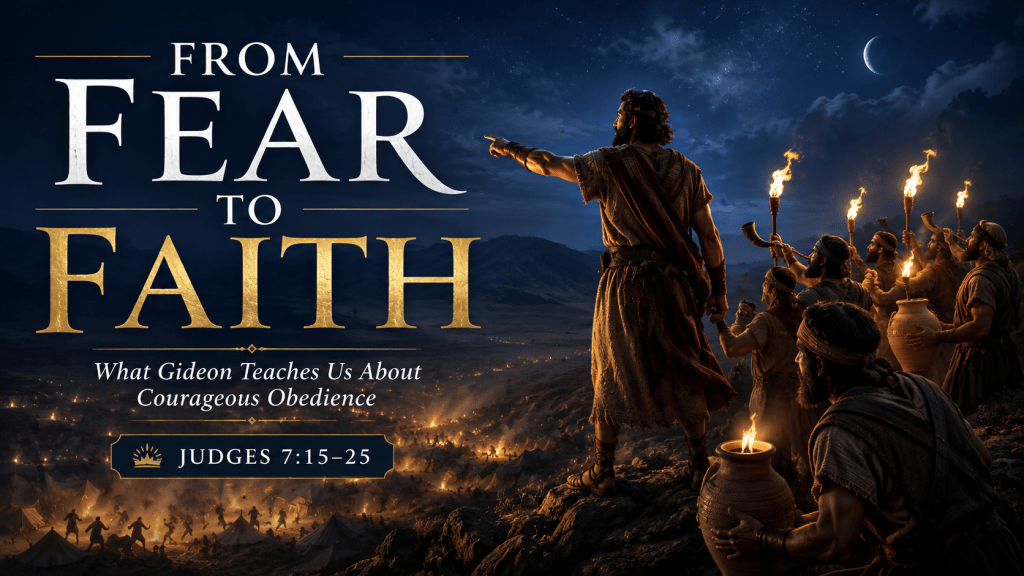
Primary Scripture: Judges 7:15–25, NASB 2020
Gideon’s story is one of the clearest examples in Scripture of what God can accomplish through an ordinary person who becomes willing to trust and obey Him.
When God first called Gideon, he was hiding in a winepress. He was afraid of the Midianites, uncertain about his own abilities, and filled with questions. He wondered why Israel was suffering, where God’s miraculous power had gone, and how someone from such an insignificant background could possibly deliver the nation.
By the time we reach Judges 7:15–25, however, Gideon is no longer hiding.
The frightened farmer has become a courageous leader. The man who repeatedly asked for signs is now giving instructions. The doubter is preparing to lead three hundred men against an overwhelmingly larger enemy.
What produced this transformation?
Gideon had learned that victory did not depend upon the size of his army, the strength of his personality, or the superiority of his weapons. Victory depended upon the presence, promise, and power of God.
Worship Before Warfare
Immediately before Gideon returned to his men, God allowed him to overhear a Midianite soldier describing a dream. Another soldier interpreted the dream as a sign that God had given Midian into Gideon’s hands.
Judges 7:15 tells us that when Gideon heard the dream and its interpretation, he bowed in worship.
That response is significant.
Gideon did not immediately begin shouting orders. He did not congratulate himself for being chosen. He did not rush back to the Israelite camp and take credit for the coming victory.
He worshiped.
Before Gideon went to war, he acknowledged the God who had promised to give the victory.
Worship places our circumstances in their proper perspective. It reminds us that God is greater than the opposition standing before us. It shifts our attention away from our limited resources and places it upon God’s unlimited power.
When Gideon returned to his men, he did so with renewed confidence. He was able to announce that the Lord had given the Midianite camp into their hands.
The circumstances had not changed. Gideon still had only three hundred men. The Midianite army was still enormous. The human odds were still impossible.
What changed was Gideon.
Fear had given way to faith because Gideon had heard the promise of God and responded in worship.
The same pattern is important for us. Before we face the challenges before us, we must spend time in the presence of the One who goes before us. Worship does not always remove the battle, but it prepares our hearts to enter the battle with confidence in God.
Courageous Obedience Moves Faith Into Action
Gideon’s renewed faith had to become more than an emotional experience. He still had to return to the camp, organize the men, explain the strategy, and lead them toward the enemy.
God had promised the victory, but Gideon still had to obey.
Biblical faith is never merely intellectual agreement. Genuine faith responds to God’s Word with action.
There is usually enough evidence to encourage our faith and enough uncertainty to stretch it. God often reveals the next step without showing us every detail of the road ahead. He calls us to depend upon Him one decision at a time.
Gideon could have remained near the Midianite camp discussing the dream with his servant. He could have celebrated the encouragement without doing anything with it. Instead, he returned to the three hundred men and prepared them to move.
Many believers remain spiritually stuck because they agree with God’s Word but hesitate to act upon it. We believe God can use us, but we refuse to step forward. We believe God forgives, but we continue carrying our guilt. We believe prayer matters, but we fail to pray. We believe the gospel must be shared, but we remain silent.
Gideon teaches us that faith must eventually leave the safety of discussion and enter the uncertainty of obedience.
We may not understand everything God is doing, but we can obey what He has clearly told us to do.
Godly Leaders Lead by Example
Gideon divided his three hundred men into three groups and gave each man a trumpet, an empty clay jar, and a torch. He then told them:
“Look at me and do likewise.”
—Judges 7:17, NASB 2020
Gideon was not asking his men to do something he was unwilling to do himself. He would be present with them. He would take the same risks, follow the same plan, and stand in the same dangerous position.
That is one of the central principles of biblical leadership: godly leaders lead by example.
Leadership is not merely holding a title, giving instructions, or occupying a visible position. Leadership is living in such a way that others can safely follow our example.
The New Testament repeatedly emphasizes this truth. Paul instructed Timothy to be an example to believers in speech, conduct, love, faith, and purity (1 Timothy 4:12). Peter instructed elders not to dominate those entrusted to them but to prove themselves examples to the flock (1 Peter 5:2–3).
Christian leaders must never attempt to lead people farther than they are willing to go themselves.
A leader who calls others to pray must be a person of prayer. A leader who teaches generosity must practice generosity. A leader who demands integrity must live with integrity. A leader who calls others to trust God must demonstrate that trust when circumstances become difficult.
Gideon had once hidden in fear, but God had patiently prepared him to stand before others and say, “Look at me and do likewise.”
God is still transforming fearful people into faithful leaders. He is still shaping men and women whose lives can become examples of courageous obedience.
Wisdom Uses What God Has Provided
Gideon’s strategy was simple, creative, and effective.
Each man carried a trumpet, a clay jar, and a torch. The torches were initially concealed inside the jars as the men surrounded the Midianite camp. At Gideon’s signal, the three hundred men blew their trumpets, shattered the jars, raised the torches, and shouted:
“A sword for the Lord and for Gideon!”
—Judges 7:20, NASB 2020
The attack came during the night near the changing of the guard. The sudden sound of three hundred trumpets, the crashing of clay jars, the appearance of torches around the camp, and the shouting of the Israelites created confusion and panic.
The Midianites apparently believed that an enormous army had surrounded them. In the darkness and confusion, they turned their swords against one another and began to flee.
Gideon used what God had placed in his hands.
He did not have thousands of soldiers, but he had three hundred obedient men. He did not have superior military equipment, but he had trumpets, jars, and torches. He did not possess the resources people normally associate with victory, but he had enough to obey God.
We often focus so heavily on what we do not have that we overlook what God has already provided.
We may not have a large budget, a prominent platform, advanced training, or an impressive organization. We may feel that our abilities are too limited and our influence too small.
God, however, is not limited by our limitations.
Faith does not ignore practical planning. Gideon carefully divided the men, explained the strategy, chose the proper moment, and positioned the groups around the camp. He did everything he could with what he had, and he trusted God to accomplish what only God could do.
Faithful ministry requires both dependence upon God and responsible action. We pray as though everything depends upon God, and we obey as people who understand that God has given us a responsibility.
The Power Belongs to God
Gideon and his men frightened the Midianite army, but God brought the victory.
Judges 7:22 explains that the Lord caused the swords of the Midianites to be turned against one another throughout the camp. Their great numbers, which had once appeared to guarantee their victory, contributed to their confusion and destruction.
The Israelites did not defeat Midian because they possessed greater strength. God intentionally reduced Gideon’s army so that Israel could not boast that its own power had delivered the nation.
From beginning to end, this was God’s victory.
The trumpets, jars, and torches also provide a helpful picture of an important New Testament truth:
“But we have this treasure in earthen containers, so that the extraordinary greatness of the power will be of God and not from ourselves.”
—2 Corinthians 4:7, NASB 2020
We are the earthen containers. We are fragile, limited, and ordinary. Yet God has placed the treasure of the gospel within His people.
The power is not found in the container. The power belongs to God.
Our weakness does not disqualify us from being used by God. In many cases, our weakness becomes the setting in which His strength is most clearly displayed. When God works through obviously inadequate people and limited resources, He receives the glory.
This does not mean believers will never experience hardship, disappointment, persecution, or loss. Faith is not a guarantee that every difficult circumstance will end according to our personal desires. It is confidence that God remains sovereign, faithful, and present even when we cannot see the final outcome.
The question is not whether we are strong enough to accomplish God’s purposes. The question is whether we are willing to make ourselves available to Him.
God Can Transform Anyone
The transformation of Gideon is as remarkable as the defeat of Midian.
The story began with Gideon hiding in a winepress. By Judges 7, he was standing before three hundred men as their leader. He had moved from questioning God to trusting Him, from requesting signs to giving instructions, and from fearfully hiding to courageously obeying.
God did not merely change Gideon’s circumstances. God changed Gideon.
That same transforming power is available through Jesus Christ.
“Therefore if anyone is in Christ, this person is a new creation; the old things passed away; behold, new things have come.”
—2 Corinthians 5:17, NASB 2020
The good news of the gospel is that we do not have to remain who we once were.
Through Christ, the guilty can be forgiven. The spiritually dead can receive life. The fearful can learn courage. The doubting can develop faith. The broken can experience restoration. The person who once hid from responsibility can become someone God uses to strengthen others.
Transformation is not accomplished through willpower alone. It is the work of God within a person who has placed his or her faith in Jesus Christ.
Gideon’s life reminds us not to define people only by where they are now. God sees what His grace can produce in them.
The person who appears weak today may become a courageous leader tomorrow. The believer filled with questions may become someone who strengthens the faith of others. The person who feels insignificant may become an instrument through whom God accomplishes something extraordinary.
God Does Not Need “Bigness”
After the Midianites fled, Gideon summoned reinforcements from Naphtali, Asher, and Manasseh. He also called upon the Ephraimites to secure the crossings of the Jordan River. The Ephraimites captured Oreb and Zeeb, two Midianite leaders, and the victory became a defining moment in Israel’s history.
God began the victory with three hundred available men.
This truth carries an important lesson for the church.
We can easily become impressed by large buildings, large crowds, large budgets, popular personalities, and highly polished programs. None of those things is automatically wrong, but they become dangerous when we begin trusting them more than we trust God.
God does not need impressive numbers to accomplish His purposes. He desires people who are surrendered, faithful, obedient, and available.
A small congregation that depends upon God can have a lasting impact upon its community. A single believer who faithfully shares the gospel can influence generations. A ministry with limited resources can accomplish significant work when its people seek God’s wisdom and steward what He has provided.
The victory does not belong to the largest group. The victory belongs to God.
First John 5:4 declares:
“For whoever has been born of God overcomes the world; and this is the victory that has overcome the world: our faith.”
—1 John 5:4, NASB 2020
Faith is not confidence in ourselves. It is confidence in the character, promises, presence, and power of God.
Moving From Faith to Fulfillment
Gideon’s story challenges us to move from theory to action.
God may be calling you to take a step that feels larger than your abilities. He may be asking you to serve, lead, forgive, speak, give, begin again, or trust Him in an area you have attempted to control.
The obstacles may appear overwhelming. Your resources may appear inadequate. Your past may tell you that you are not qualified.
Remember Gideon.
Remember the winepress. Remember the questions. Remember the three hundred men. Remember the trumpets, jars, and torches. Most importantly, remember the God who transformed a fearful farmer and used him to deliver a nation.
You do not need to understand every detail of God’s plan before obeying the next instruction. You do not need unlimited resources before making yourself available. You do not need to become fearless before taking a courageous step.
Courage is not the absence of fear. Courage is choosing to obey God in the presence of fear.
Worship Him before the battle. Listen carefully to His Word. Use wisely what He has placed in your hands. Lead by example. Step forward in obedience. Trust God to accomplish what you could never accomplish on your own.
We may not fully understand His plans, but we can fully trust His promises.


 Patrick Ryan Lewis
Leave a comment