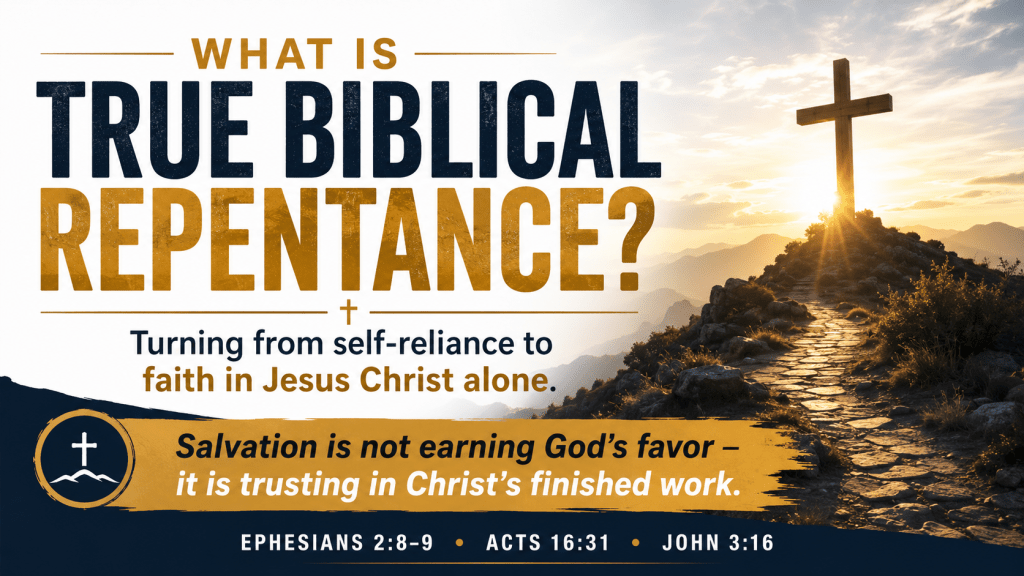
Repentance is one of the most important—and often misunderstood—teachings in the Bible. Some people think repentance means feeling sorry for sin, promising to become a better person, or cleaning up their lives before coming to God. Others treat repentance as a religious work that must be performed to earn forgiveness.
Biblical repentance is not an attempt to make ourselves worthy of salvation. It is a change of mind and heart that turns us away from unbelief, self-righteousness, and confidence in our own works—and turns us toward faith in Jesus Christ alone.
Repentance Is More Than Feeling Sorry
Feeling sorrow over sin can be part of repentance, but sorrow by itself is not repentance. A person may regret the consequences of sin without truly turning to God.
True repentance recognizes that we are sinners who cannot save ourselves.
“For all have sinned and fall short of the glory of God.”
— Romans 3:23
Repentance begins when we stop defending ourselves, stop trusting in our own goodness, and agree with God about our need for a Savior.
It is not simply saying, “I need to do better.”
It is admitting, “I cannot save myself. I need Jesus.”
Turning From Self-Reliance
Human nature wants to earn God’s favor. We may trust in good deeds, church attendance, religious traditions, generosity, morality, or personal accomplishments. While good works have an important place in the Christian life, they cannot purchase salvation.
Hebrews speaks of “repentance from dead works and faith toward God” in Hebrews 6:1. Dead works include anything we depend upon instead of Christ’s finished work.
Repentance means abandoning the belief that our efforts can make us righteous before God. We stop trusting in ourselves and place our confidence completely in Jesus Christ.
Turning to Faith in Jesus Christ
When the Philippian jailer asked Paul and Silas what he needed to do to be saved, their answer was clear:
“Believe in the Lord Jesus, and you will be saved.”
— Acts 16:31
The Gospel is not a complicated system of religious achievements. It is the good news of what Jesus has already accomplished.
Jesus Christ died for our sins. He was buried. He rose again on the third day. Through His death and resurrection, He accomplished everything necessary to provide forgiveness and eternal life.
“Christ died for our sins according to the Scriptures, and that He was buried, and that He was raised on the third day according to the Scriptures.”
— 1 Corinthians 15:3–4
True repentance turns us away from unbelief and toward the truth of the Gospel. It leads us to trust in Christ as our only Savior.
Salvation Is Received by Grace Through Faith
Salvation is God’s gift. It cannot be earned, purchased, or deserved.
“For by grace you have been saved through faith; and this is not of yourselves, it is the gift of God; not a result of works, so that no one may boast.”
— Ephesians 2:8–9
Repentance is not an additional work we perform to convince God to save us. It is the change of mind that recognizes our helpless condition and turns to Christ in faith.
We come to God with empty hands, trusting completely in the finished work of Jesus.
The Simple Message of the Gospel
The biblical response to the Gospel can be summarized in four truths:
Recognize Your Need
Understand that you are a sinner and cannot save yourself. Every person has fallen short of God’s perfect standard.
Turn From Self-Reliance
Stop trusting in your morality, religion, accomplishments, or good works to make you right with God.
Trust in Christ Alone
Place your faith in Jesus Christ—His death for your sins, His burial, and His resurrection.
Receive Salvation by Grace Through Faith
Accept eternal life as God’s gift, not as a reward for your performance.
Jesus said:
“For God so loved the world, that He gave His only Son, so that everyone who believes in Him will not perish, but have eternal life.”
— John 3:16
Repentance Is Not Cleaning Yourself Up for God
Many people believe they must fix themselves before coming to Christ. They think they need to overcome every struggle, abandon every bad habit, or become religious enough for God to accept them.
But we do not clean ourselves up so that we can come to God. We come to God because we know we cannot clean ourselves up.
Jesus receives sinners who come to Him in faith. Salvation begins with His grace, not our improvement. A transformed life follows salvation as the Holy Spirit works within the believer, but transformation is the fruit of salvation—not the price of it.
Trust in Christ’s Finished Work
On the cross, Jesus declared:
“It is finished.”
— John 19:30
Christ completed the work required for our redemption. Nothing needs to be added to His sacrifice.
True biblical repentance means changing our minds about sin, ourselves, and the Savior. We stop trusting in our own righteousness and place our faith in Jesus Christ alone.
The Gospel is simple. Christ died for our sins, was buried, and rose again. The response is faith.
Do not wait until you believe you are good enough. Come to Christ as you are. Turn from unbelief and self-reliance, and trust in His finished work for forgiveness and eternal life.
“Truly, truly, I say to you, the one who hears My word, and believes Him who sent Me, has eternal life, and does not come into judgment, but has passed out of death into life.”
— John 5:24
Salvation is not earning God’s favor. It is trusting in Christ’s finished work.


 Patrick Ryan Lewis
Leave a comment