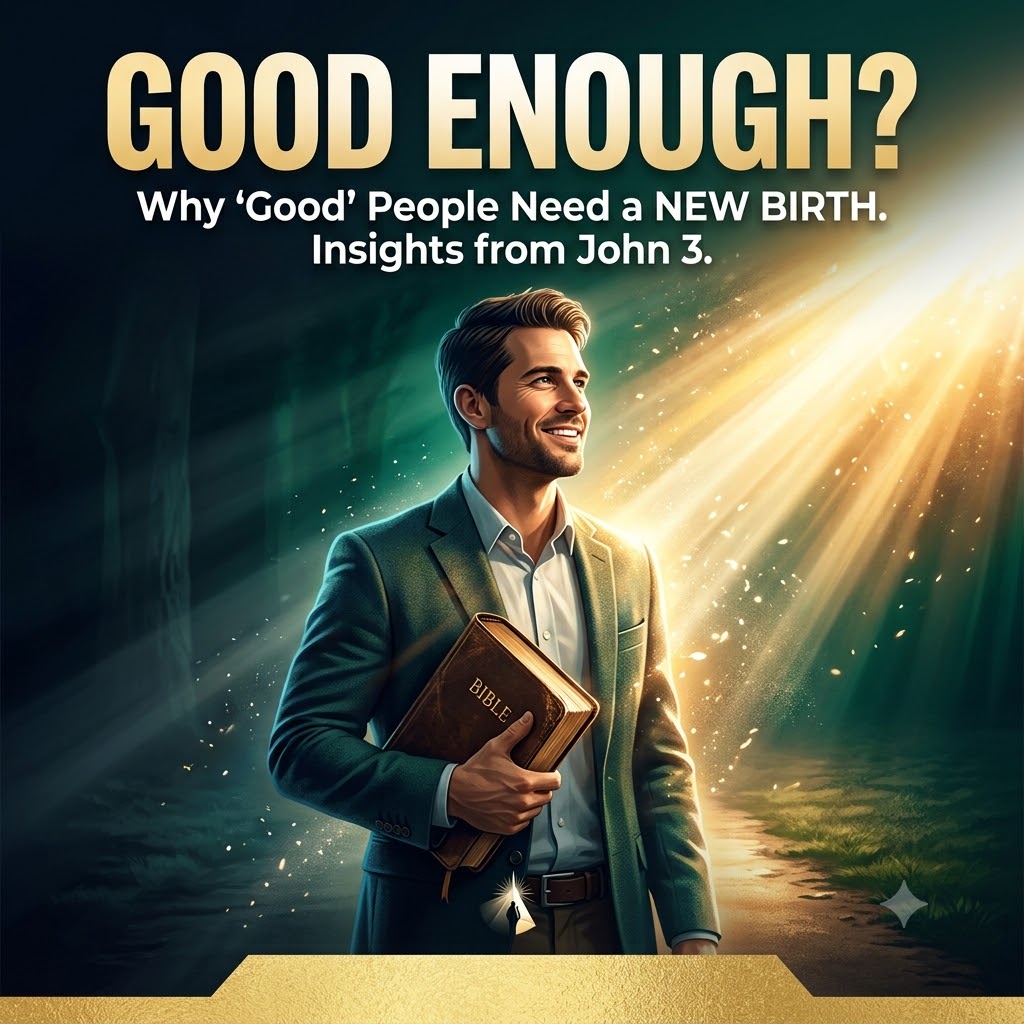
When we read the opening of John 3, we often bring a specific image to mind. We think of Jesus rescuing a desperate outcast or correcting a rebellious skeptic.
But Nicodemus was none of those things. He wasn’t an atheist, a moral failure, or a social outsider. He was deeply religious, highly educated, widely respected, and morally serious.
This means that John 3 isn’t just a story about how “bad” people need God. It is a striking wake-up call about how good, religious people need a new birth. Nicodemus came to Jesus with theological curiosity, but Jesus bypassed the academic debate and confronted him with a spiritual necessity: “You must be born again.”
Nicodemus is draped in shadow—literal and spiritual. He has the credentials, the status, and the respect of his peers, yet he seeks out Jesus in the dark. He is close to the Light, but not yet in it.
To understand why this conversation is so vital for us today, we have to look past the famous declaration of John 3:16 and dive into the diagnosis that follows in verses 17–21.
1. Sent to Save, Not to Condemn (John 3:17)
John 3:17 is the essential partner to John 3:16. It guards us against viewing God’s love as mere sentimentality. God’s love isn’t passive; it moves, acts, and sends.
“For God did not send his Son into the world to condemn the world, but to save the world through him.” (John 3:17)
To fully appreciate this rescue mission, we have to understand three key words:
- “Sent”: The Greek word implies being sent with distinct purpose, authority, and commission. Jesus didn’t show up on earth by accident, nor was He simply a good teacher trying His best. He was sent as the authorized Savior from the Father’s heart. This is not God’s backup plan; it is His primary rescue mission.
- “World” (Kosmos): In John’s Gospel, “the world” rarely refers to the physical planet. Instead, it refers to humanity in its fallen, rebellious, and spiritually bankrupt condition. The world is not innocent, nor is it actively seeking God on its own.
- “Condemn” (Krinō): Jesus reveals that His primary mission was not to enter the world to hand down sentences. While He doesn’t deny that judgment exists, He shows that judgment isn’t because God refused to save—it’s because humanity refuses the Savior.
The Gospel begins with God reaching downward to a world that could never reach upward on its own. Salvation is not a self-improvement project; it is a rescue operation.
2. The Great Divide: Intellectual Agreement vs. Relentless Trust (John 3:18)
How do we receive this rescue? John 3:18 makes the deciding issue incredibly simple, yet deeply challenging: belief.
But biblical belief is far more than intellectual agreement. Nicodemus believed Jesus was “sent from God” as a teacher (John 3:2). He respected Him. But Jesus pressed him deeper. It is entirely possible to respect Jesus, admire His teaching, and still remain entirely in the dark.
True, saving belief is relentless trust. It means to:
- Rely on Him entirely.
- Cling to His work on the cross.
- Entrust your entire life, future, and eternity to Him.
The Verdict has Shifted
For those who trust in Christ, the verdict has already changed. You aren’t waiting for the final judgment to find out if you are accepted. You are accepted now because you are covered by the Son.
Conversely, the scripture notes that anyone who does not believe “has already been judged.” This isn’t a future threat; it is a present reality. Jesus didn’t bring darkness into the world—He exposed the darkness that was already there. Unbelief is not a neutral stance; it is a decision to remain outside the safety of the lifeboat.
3. The Light and What We Truly Love (John 3:19-20)
If salvation is free, and God’s love is so vast, why do people still reject Him? Jesus diagnoses the human heart with painful, clinical honesty: The problem is not a lack of light; it is a love for darkness.
Look at the contrast between these two forces:
- God loved the world (John 3:16).
- People loved the darkness (John 3:19).
This is the great tragedy of human sin. Sin is not just bad behavior; it is disordered love. We don’t just trip and fall into the dark; we protect it, excuse it, and hide in it because we love the control we think it gives us.
We must remember that darkness isn’t always scandalous.
- Some darkness is messy and obvious.
- Some darkness is highly respectable, wears a suit, carries a Bible, and comes to Jesus under the cover of night.
Nicodemus represents the “respectable” darkness. He had to realize that his moral achievements and religious credentials were just another way of keeping Jesus at arm’s length.
He wanted a teacher he could analyze; Jesus wanted a Lord to whom he would surrender.
Light does not only show us where to walk. Light also shows us what we have been trying to hide.
4. The Path of Honest Surrender (John 3:21)
How do we respond to the light? We practice what John calls “doing the truth.”
True faith is not just something we think; it is something we live. Coming to the light means stepping out of the shadows of self-reliance and laying everything bare before God. It means praying a prayer of honest surrender:
“Lord, here is my sin. Here is my fear, my pride, and my exhausting attempt at religion without rebirth. Here is my hidden life. Shine on me. Save me. Change me.”
When you step into the light, you don’t do it because you are perfect. You do it because you are willing to be made honest.
Once you step into that light, all religious boasting dies. You no longer say, “Look at what a good person I am.” Instead, you point to the light and say, “Look at what a great Savior God is.” The very light that exposes your sin is the exact same light that reveals His breathtaking grace.
The Verdict is Yours
John 3:16 is the declaration of God’s love. John 3:17-21 is the diagnosis of our hearts.
God has loved, sent, and offered life. The invitation is not to clean yourself up in the dark before you step out. The invitation is to come into the light exactly as you are—with your questions, your moral achievements, your hidden failures, and your pride—and let the Savior do what He was sent to do: save you.


 Patrick Ryan Lewis
Leave a comment